Chinese EVs in Pakistan 2026: How BYD and Hybrid Cars Are Changing the Market

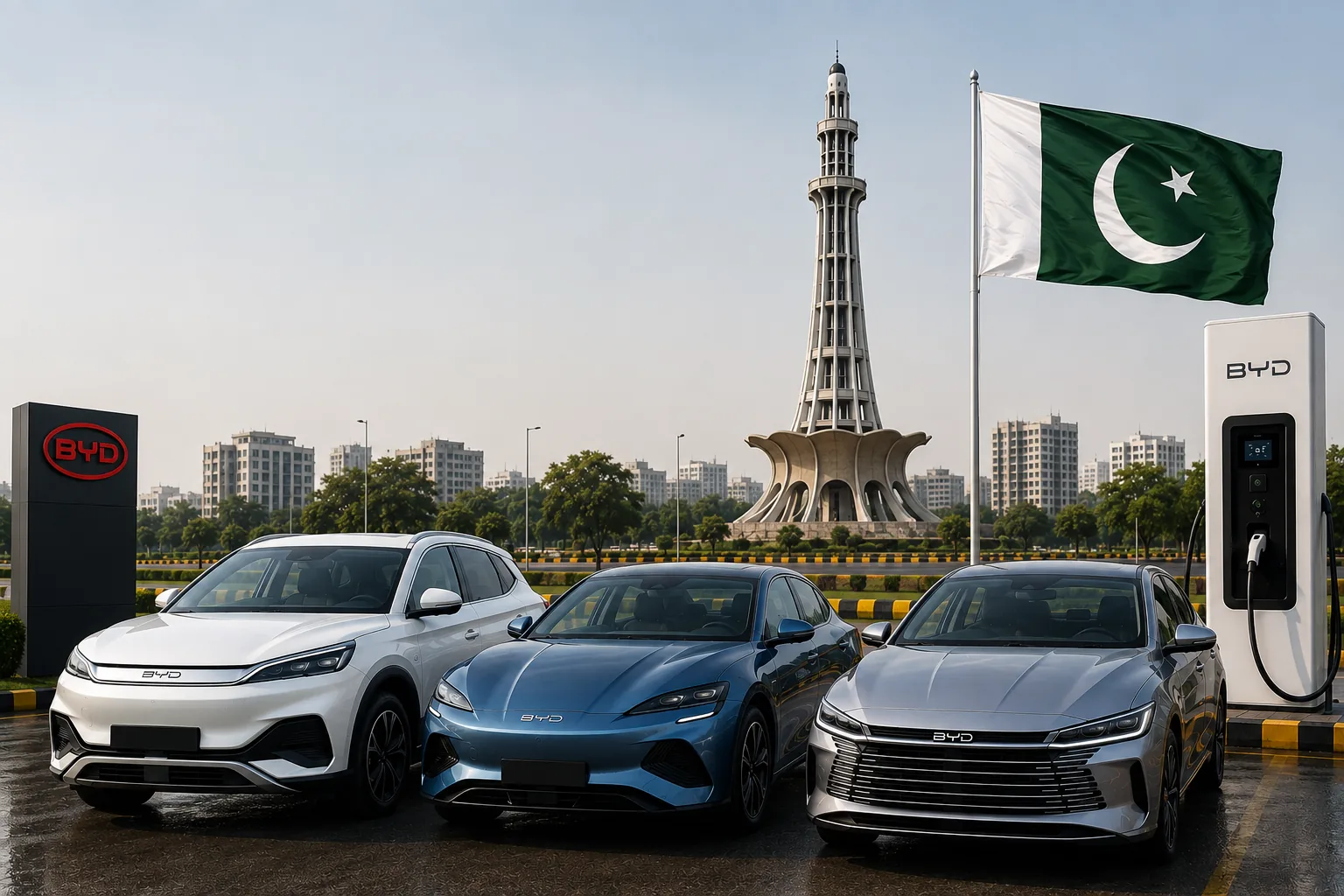
For decades, buying a car in Pakistan meant picking between a handful of Japanese names and waiting months for delivery. That’s no longer the whole story. Chinese electric vehicles and hybrids have moved from a niche import curiosity to a genuine market shift in 2026, led by BYD’s push into local manufacturing and a wave of new plug-in hybrid models from Haval, Chery, and other Chinese brands.
Quick Answer: BYD is building a $150 million assembly plant near Karachi, its first locally built vehicles expected later in 2026. Alongside it, Chinese hybrid models from Haval and Chery are gaining ground, helped by 0% Federal Excise Duty on EVs under Rs. 20 million. Charging infrastructure and long-term reliability data are still catching up.
Quick Facts: Chinese EVs in Pakistan 2026
BYD leads Pakistan’s Chinese EV market with a $150 million assembly plant nearing completion in Sindh. Government duty cuts, a growing charging network, and rising Chinese hybrid imports are reshaping a market Japanese brands once had to themselves.
| Fact | Detail |
| Leading brand | BYD, via Mega Motor Company (a HUBCO subsidiary) |
| BYD entry | 2024, with imported EVs; ~2,000 units sold in 2025 |
| Local assembly plant | Gharo, Sindh; $150 million investment; ~25,000 vehicles/year capacity |
| Local assembly target | Q3-Q4 2026 (previously cited as July-August 2026) |
| BYD Atto 3 price | PKR 8,990,000 (Advance variant) |
| BYD Atto 2 price | PKR 7,290,000 |
| Import duty (Budget 2026-27) | 0% Federal Excise Duty (FED) on EVs valued up to Rs. 20 million |
| Charging network | 19 DC fast-charging stations, Karachi to Peshawar (HUBCO Green) |
| Other active brands | Haval (GWM), Chery, Deepal, Jetour, MG, Changan |
| EV/NEV policy target | 30% of new vehicle sales by 2030 |
Why Is the Chinese EV Market Growing So Fast in Pakistan?
Three things are converging at once: rising fuel-cost fatigue, new tax incentives, and Chinese automakers with spare manufacturing capacity hunting for new markets.
Chinese EV Imports Are Up Sharply
Pakistan’s imports of Chinese plug-in hybrid vehicles rose sharply in the first half of 2026, with some vehicle categories seeing import values multiply nearly elevenfold year-on-year, according to trade data reported by China Economic Net. PHEV 4WD crossovers, almost absent from Pakistan’s market a year earlier, alone brought in over $123 million.
Part of this surge traces back to China itself. Roughly 40% of the country’s EV production capacity reportedly sits unused, and export markets like Pakistan are where that spare capacity is landing.
Chinese Automakers Are Targeting a Gap Japanese Brands Left Open
Toyota, Suzuki, and Honda have dominated Pakistan’s small car and sedan segment for decades, backed by local assembly and tight distribution networks.
Chinese brands have largely sidestepped that fight. Instead, they’ve focused on SUVs, hybrids, and EVs, a segment where Japanese competition has historically been thin, giving new entrants room to establish themselves without a direct price war.
BYD Pakistan: Local Assembly, Models, and Market Expansion
BYD, often described as Tesla’s biggest global rival, entered Pakistan’s market in 2024 as an importer, through its official local partner Mega Motor Company, an associate company of Hub Power Holdings (HUBCO). It has since become, by some industry estimates, the country’s largest EV brand by volume.
BYD’s Local Assembly Plant
BYD’s Gharo, Sindh plant is in its final construction stages, with equipment installation and testing underway, according to Business Recorder.
- Investment: $150 million
- Capacity: ~25,000 vehicles per year
- Powertrains: Fully electric and plug-in hybrid models
- Timeline: Originally targeted July-August 2026; more recent reports cite Q3-Q4 2026
BYD’s Current Lineup and Pricing
Chinese EV prices in Pakistan vary widely by brand, but here’s where BYD’s two current models stand:
- BYD Atto 3 (Advance variant): PKR 8,990,000, BYD’s first model in Pakistan (launched August 2024) and still its best-selling SUV.
- BYD Atto 2: PKR 7,290,000, launched January 2026 as a more accessible entry point.
- BYD Shark 6: A plug-in hybrid pickup truck, launched in 2025, notable as one of the only PHEV pickups sold in Pakistan.
BYD’s Charging Network Strategy
BYD’s charging push runs through its partner HUBCO Green, built out well ahead of its assembly plant.
- Current network: 19 public DC fast-charging stations
- Coverage: ~1,300 km corridor from Karachi to Peshawar
- Next phase: Expansion into new cities, major travel routes, and Tier 2 urban centres
Chinese Hybrid Cars in Pakistan: Models and Prices
Alongside BYD’s EV push, Chinese hybrid cars in Pakistan are becoming a serious mainstream option rather than just an EV alternative for cautious buyers.
Haval’s PHEV Lineup
Great Wall Motor’s Haval brand, locally assembled since 2021, has positioned its H6 PHEV (built on Hi4 hybrid technology) as what the company calls Pakistan’s fastest locally assembled C-segment SUV. Current pricing:
- Haval Jolion (petrol): PKR 7,796,106
- Haval H6 (petrol): PKR 12,895,000
- Haval Jolion Hybrid: Not officially confirmed; industry estimates PKR 9.8-11.5 million
- Haval H6 Hybrid: Not officially confirmed; industry estimates PKR 12.5-14.5 million
Other Chinese Brands Building a Presence
Beyond BYD and Haval, several other Chinese brands are building local footprints:
- Chery (via Chery Master Pakistan): locally assembled Tiggo 8 and Tiggo 9.
- Jetour: entered through United Motors.
- Jaecoo and Omoda (Chery’s export brands): being developed locally through NexGen Auto.
- Deepal (Changan’s new-energy brand): S05, L07, S07, and E07 models, though full pricing isn’t yet consistently published.
EV vs Hybrid Cars in Pakistan: Which Makes More Sense?
For most Pakistani buyers weighing a Chinese EV against a plug-in hybrid, the decision usually comes down to charging access rather than price alone. Chokus has covered this comparison in more depth in Hybrid vs Electric Cars in Pakistan; here’s the short version.
- Charging dependency: A full EV needs regular access to charging, home or public. A PHEV runs on petrol once its electric range is used up, which matters given Pakistan’s charging network is still limited mostly to the Karachi-Peshawar corridor.
- Range anxiety: PHEVs effectively eliminate it for long trips; full EVs don’t, outside that corridor.
- Running cost: EVs benefit from a subsidized charging tariff of Rs. 39.70 per unit at public stations, well below regular commercial electricity rates, which industry estimates suggest can cut travel costs by up to three times compared to petrol.
- City vs highway use: For buyers who mostly drive within one city and can charge at home, a full EV is increasingly practical. For frequent intercity travel outside the fast-charging corridor, a PHEV remains the safer bet for now.
Pakistan’s EV Policy 2026: Taxes, Imports, and Local Manufacturing
Pakistan’s Budget 2026-27 cut duty on affordable EVs sharply, directly fueling the import surge above. A bigger policy shift, the Auto Industry Development and Export Policy 2026-31, is still being finalized and could reshape pricing further.
What Changed in Budget 2026-27
The new tax structure rewards affordable EVs while taxing luxury imports more heavily, according to PakWheels:
- Under Rs. 20 million: 0% Federal Excise Duty (FED)
- Rs. 20-30 million: 30% FED
- Above Rs. 30 million: 40% FED
- EV CKD kits: Sales tax exemption extended through June 30, 2027
What the Upcoming Auto Policy 2026-31 Adds
A broader Auto Industry Development and Export Policy, still being finalized, is expected to include:
- Toll waiver: No motorway toll tax for EVs and plug-in hybrids.
- Tariff phase-out: Additional customs duties eliminated by FY2029.
- Hybrid tax cut: 9% sales tax on hybrid vehicles, half the standard 18% rate.
- NEV parts duty: 1% customs duty for the policy’s first three years, rising to 5% after.
- Local-content targets: Firm requirements meant to push manufacturers toward building in Pakistan rather than just importing.
Cheaper Electricity for EV Charging
Separately from the import duty changes, Prime Minister Shehbaz Sharif cut electricity tariffs for EV charging stations by 45% in January 2025, from Rs. 71.10 to Rs. 39.70 per unit, according to Arab News. The government has since introduced a dedicated subsidized tariff framework for EV charging under the NEV Policy 2025-30, separate from regular residential and commercial rates.
Not Everyone Is Convinced
The shift hasn’t gone uncriticized. Some commentators question whether Pakistan’s strained power grid and frequent outages can support a genuine EV transition. Officials counter that the subsidized charging tariff and new charging-station regulations are meant to close exactly that gap, though whether they’re moving fast enough remains an open question.
Frequently Asked Questions
Is BYD available in Pakistan?
Yes. BYD has sold imported EVs in Pakistan since 2024 through its partner Mega Motor Company, and is building a local assembly plant in Gharo, Sindh, expected to produce its first locally built vehicles in the second half of 2026.
What is the price of Chinese EVs in Pakistan?
BYD’s Atto 3 costs PKR 8,990,000 and the Atto 2 costs PKR 7,290,000. Prices vary significantly by brand and model, and are expected to shift once local assembly reduces import-related costs.
Are Chinese hybrid cars reliable in Pakistan?
Long-term reliability data specific to Pakistan’s roads and climate is still limited, since most Chinese hybrid and EV models have only been sold locally for one to three years. Buyers should verify battery and vehicle warranty terms directly with dealers rather than relying on global reliability figures alone.
Which is better in Pakistan, an EV or a hybrid car?
It depends on driving pattern. A full EV suits buyers who mostly drive within a city and can charge at home. A plug-in hybrid suits buyers who travel between cities frequently, since Pakistan’s fast-charging network is still concentrated along the Karachi-Peshawar corridor.
Are EV charging stations available in Pakistan?
Yes, though coverage of EV charging stations in Pakistan is still limited. HUBCO Green operates 19 DC fast-charging stations spanning roughly 1,300 kilometres from Karachi to Peshawar, with expansion into other cities planned as demand grows.
When will BYD start local assembly in Pakistan?
BYD’s Gharo, Sindh plant is in its final construction stages as of mid-2026. The company has cited timelines ranging from July-August 2026 to the third or fourth quarter of 2026 for its first locally assembled vehicle.
What are the disadvantages of Chinese EVs in Pakistan?
Limited charging infrastructure outside the Karachi-Peshawar corridor, unproven long-term reliability in local conditions, and higher upfront prices than comparable petrol vehicles are the main trade-offs, though import duty cuts are narrowing the price gap.
What This Means for Pakistan’s Car Market
Chinese EVs in Pakistan have moved past the early-adopter phase, with BYD’s plant nearing completion and multiple Chinese brands now competing on SUVs and hybrids, exactly where Japanese manufacturers left a gap. Whether that becomes mainstream adoption depends on two things: how far the charging network expands beyond the Karachi-Peshawar corridor, and whether BYD’s assembly timeline holds.
For more on Pakistan’s shifting auto and tech landscape, follow Chokus’s ongoing Pakistan news coverage and technology coverage.
Are you considering a Chinese EV or hybrid for your next car, or waiting for local assembly to bring prices down? Share your thoughts in the comments.
Written by Huzaifa Khan, who covers Pakistan’s technology and economy beat for Chokus. Last updated August 6, 2026. Pricing and timelines for local assembly are based on the most recent company and government statements available and may change.

Top 10 Best Swimming Pools for Kids in Karachi for Safe Family Fun
Fastest 4G Network in Pakistan: Which Network Comes Out on Top?