
Hybrid vs EV in Pakistan (2026): Cost, Charging, Maintenance & Real World Reality

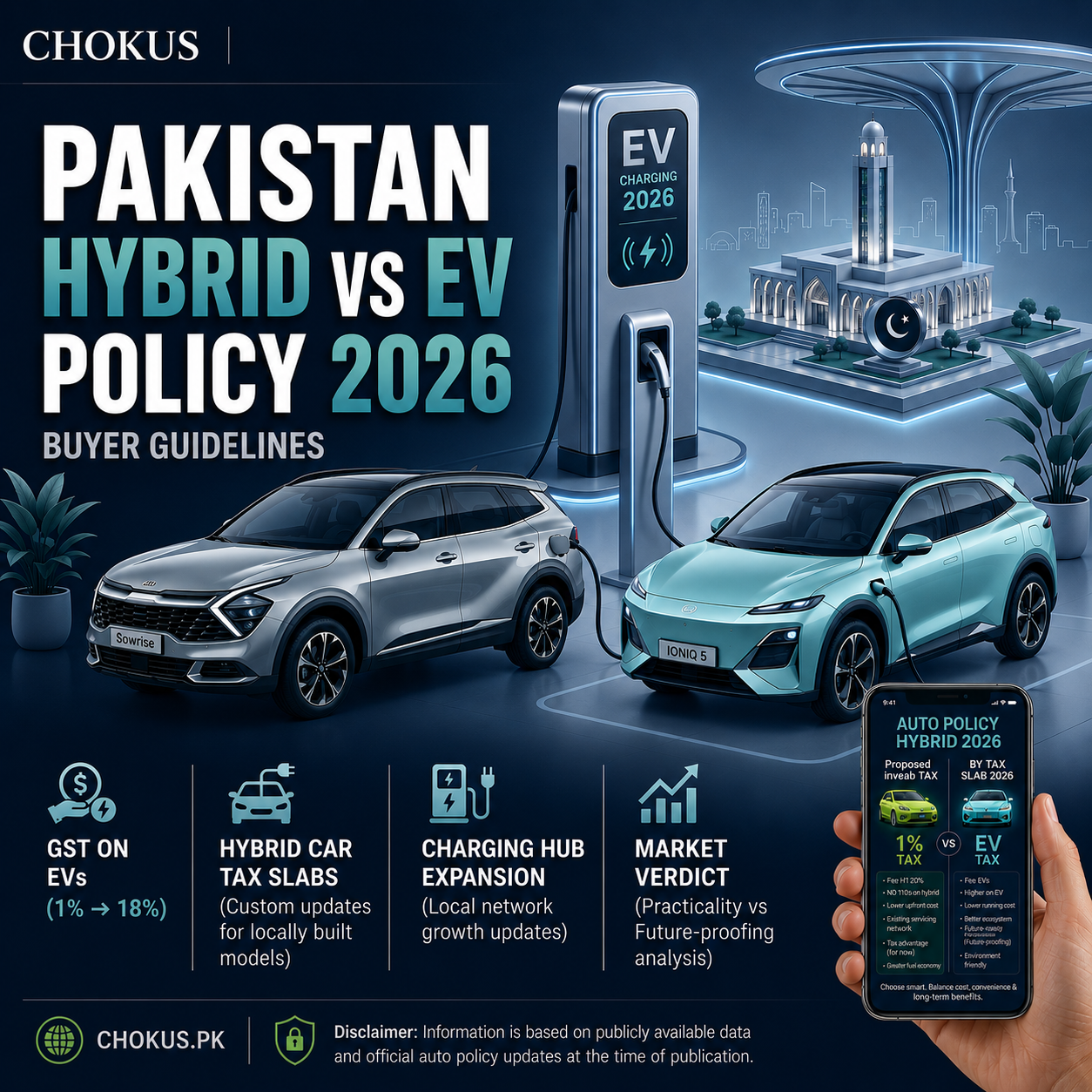
Pakistan’s automotive market is rapidly shifting as fuel prices rise and global manufacturers introduce new electrified vehicles. In 2026, buyers are no longer asking whether they should move away from petrol cars, but instead they are comparing hybrid and electric vehicles to decide which option fits their lifestyle.
Hybrid and electric vehicles both promise lower running costs and better efficiency, but their performance in Pakistan is very different due to infrastructure, electricity stability, charging availability, and resale market behavior. Understanding these differences is essential before making a purchase decision.
Understanding Hybrid Cars in Pakistan
Hybrid vehicles combine a petrol engine with an electric motor. The system automatically switches between the two power sources depending on driving conditions. In slow city traffic, the electric motor supports fuel saving, while at higher speeds the petrol engine takes control.
In Pakistan, hybrids are currently the most practical form of electrified transport because they do not require charging stations or changes in driving habits. Drivers simply refill petrol as usual while benefiting from improved fuel economy.
Hybrids are especially effective in congested cities like Karachi and Lahore, where stop-and-go traffic is common. In such conditions, the electric motor reduces fuel consumption significantly.
Understanding Electric Vehicles in Pakistan
Electric vehicles run entirely on battery power and require external charging. They produce zero emissions during driving and are considered the future of global transportation.
However, in Pakistan, the adoption of EVs is still in its early stages. While major cities are beginning to install charging stations, the network is still limited and inconsistent. This creates challenges for long-distance travel and daily commuting unless the user has reliable home charging access.
Electric vehicles offer lower running costs per kilometer compared to hybrids, but the initial purchase price and infrastructure limitations still restrict mass adoption.
Cost Comparison Between Hybrid and EV in Pakistan
One of the most important factors for Pakistani buyers is cost. This includes not only the purchase price but also fuel or electricity expense, maintenance, and long-term ownership cost.
Below is a real-world Pakistan usage breakdown based on 2026 fuel prices, electricity rates, and daily driving conditions. This comparison is designed to show actual monthly ownership cost differences instead of theoretical or marketing-based figures.
Factor | Hybrid Car (Toyota Prius Type) | Electric Vehicle (EV Sedan Class) |
Average Purchase Price (Pakistan) | Rs. 55 to 95 lakh | Rs. 70 lakh to 1.5 crore |
Fuel or Energy Cost per KM | Rs. 18 to 28 per km (city traffic is higher) | Rs. 6 to 12 per km (home charging cheapest) |
Monthly Running Cost (1500 km usage) | Rs. 28,000 to 42,000 | Rs. 10,000 to 18,000 |
Charging Requirement | Not required (petrol only) | Mandatory (home or station charging) |
Maintenance Cost (Yearly average) | Rs. 80,000 to 150,000 (engine and hybrid system) | Rs. 40,000 to 90,000 (low moving parts) |
City Driving Efficiency | Excellent in traffic conditions | Excellent with instant torque |
Long Route Reliability | Excellent (fuel stations available everywhere) | Moderate (depends on charging network) |
Battery Replacement Risk | Medium (8 to 12 years lifespan) | High cost but longer lifespan (8 to 15 years) |
Infrastructure Dependency | Low (petrol already available nationwide) | High (charging network still developing in Pakistan) |
Resale Market in Pakistan | Strong and stable demand | Developing a market with uncertain resale trends |
Below is a simplified comparison based on real-world usage in Pakistan. This comparison shows that hybrids offer balance and reliability, while electric vehicles offer lower running costs but depend heavily on infrastructure.
Charging Reality in Pakistan
Charging infrastructure is the biggest limitation for electric vehicles in Pakistan. Although progress is being made in major cities, charging stations are still not widely available across highways and smaller towns.
Most EV users rely on home charging, which works well for urban residents but becomes a challenge during long-distance travel. Electricity load shedding and variable power supply can also affect charging consistency.
In contrast, hybrids eliminate this issue because they use petrol stations, which are available nationwide.
Maintenance Differences Between Hybrid and EV
Maintenance is another key difference between the two technologies.
Hybrid vehicles require maintenance for both petrol engines and electric components. This includes engine oil changes, filters, and periodic hybrid battery checks. However, hybrid systems are highly optimized and generally reliable, especially in Japanese and Korean models.
Electric vehicles have fewer moving parts, which reduces mechanical maintenance requirements. There is no engine oil, no transmission system in the traditional sense, and fewer wear and tear components. This results in lower routine maintenance costs over time.
However, EV battery replacement cost remains a long-term concern, especially in imported models.
Real World Driving Experience in Pakistan
In real driving conditions, hybrids currently perform better for most Pakistani users. They offer consistent fuel savings without requiring changes in behavior or charging routines.
For daily commuting in traffic-heavy cities, hybrids deliver smooth and predictable performance. Drivers do not need to worry about charging schedules or range limitations.
Electric vehicles provide a more modern driving experience with instant acceleration and quieter operation. However, their effectiveness depends on access to charging infrastructure and predictable travel patterns.
For users with fixed daily routes and home charging, EVs can be highly efficient. For general users with unpredictable travel needs, hybrids remain more practical.
Environmental Impact Considerations
Both hybrid and electric vehicles reduce environmental impact compared to traditional petrol cars, but in different ways.
Hybrids reduce fuel consumption and emissions by combining electric assistance with petrol efficiency. Electric vehicles eliminate tailpipe emissions, making them more environmentally friendly during use.
However, overall environmental benefit also depends on electricity production sources. In regions where electricity comes from fossil fuels, the long-term environmental advantage of EVs becomes less direct.
Future Outlook in Pakistan
The future of both hybrid and electric vehicles in Pakistan looks promising. Hybrid vehicles are expected to dominate the short to medium-term market due to their practicality and existing infrastructure compatibility.
Electric vehicles are expected to grow gradually as charging networks expand and prices become more affordable. Government incentives and international investments in the EV sector will likely accelerate adoption over the next decade.
Pakistan’s market is currently in a transition phase where both technologies will coexist for several years before EVs potentially take the lead.
Conclusion
Hybrid and electric vehicles both represent the future of transportation in Pakistan, but they serve different needs in the current market. Hybrids are more practical for most users due to their ease of use, strong fuel efficiency, and lack of charging dependency, while electric vehicles offer long-term cost benefits and environmental advantages, but require infrastructure support that is still developing in Pakistan.

Top 10 Best Swimming Pools for Kids in Karachi for Safe Family Fun
Fastest 4G Network in Pakistan: Which Network Comes Out on Top?