
Pakistan 5G Rollout 2026: Coverage, Cities, and Everything Users Need to Know

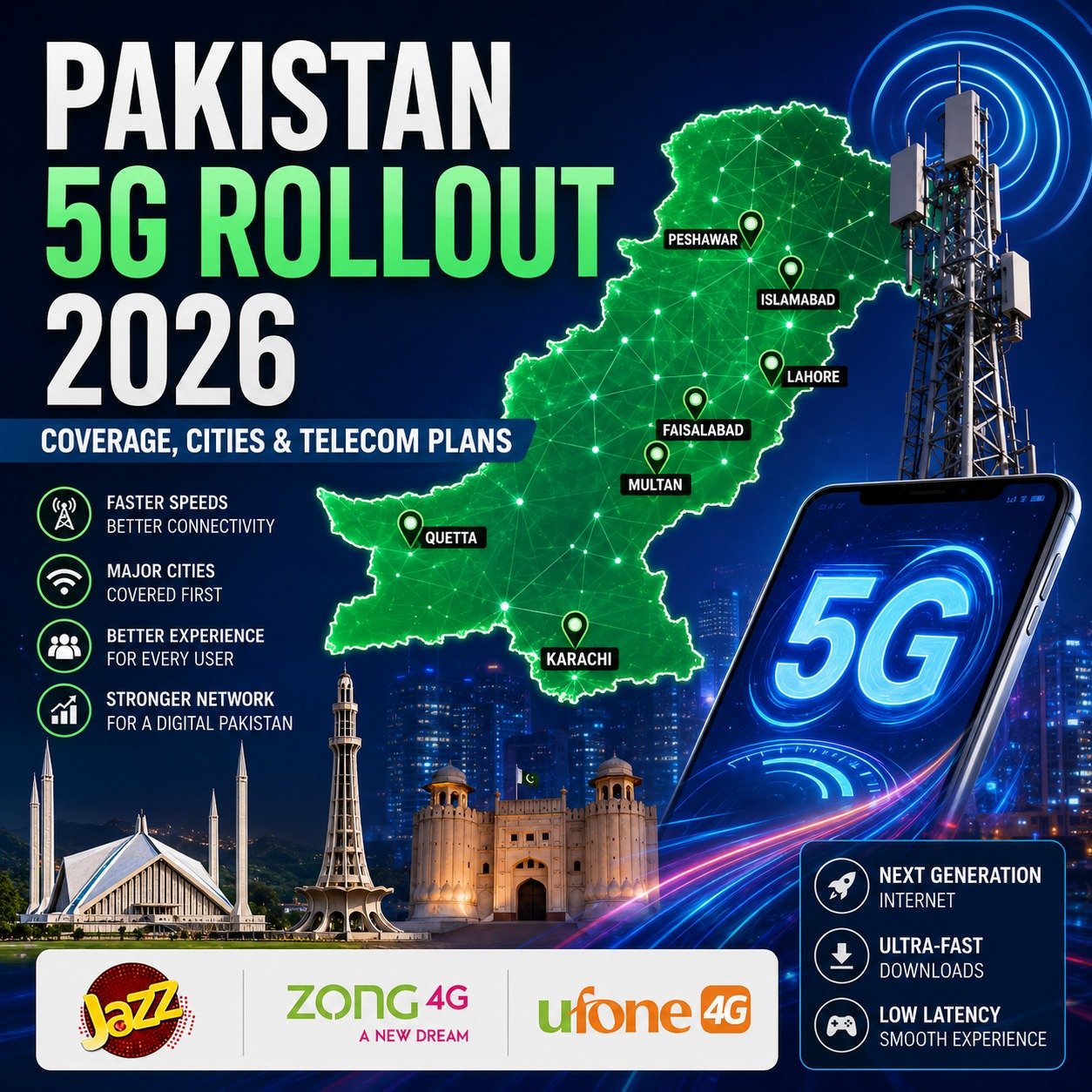
Pakistan’s telecom industry has finally entered a new phase of digital connectivity. After years of delays, policy discussions, and spectrum planning, the country’s first commercial 5G rollout is now underway. For millions of mobile users, the biggest questions are no longer whether 5G will arrive, but where it is available, which telecom operators are offering it, and when broader coverage can be expected.
The Pakistan Telecommunication Authority successfully completed the long-awaited 5G spectrum auction in March 2026, allowing major telecom companies to begin commercial deployment. The auction generated more than $507 million and marked one of the biggest milestones in Pakistan’s digital transformation journey.
This guide covers the latest status of 5G in Pakistan, telecom operators involved in the rollout, expected launch cities, user benefits, challenges, and the likely expansion timeline.
Pakistan 5G Rollout 2026 at a Glance
Key Update | Status |
5G Spectrum Auction | Completed in March 2026 |
Auction Revenue | More than $507 Million |
Telecom Operators | Jazz, Ufone, Zong |
Initial Launch Cities | Karachi, Lahore, Islamabad, Rawalpindi, Faisalabad, Multan, Peshawar, Quetta |
Rollout Type | Phased Deployment |
Nationwide Coverage | Expected Over Several Years |
The successful completion of the auction has officially moved Pakistan from planning to deployment mode.
Latest Status of 5G in Pakistan
The biggest development in 2026 is that Pakistan has already started its 5G rollout process. Following the spectrum auction, telecom operators began activating selected sites in major urban centers.
Unlike previous years when 5G remained limited to testing and pilot projects, telecom companies can now commercially deploy networks using newly acquired spectrum bands. The rollout is initially focused on high-demand urban areas before expanding to additional cities and regions.
This means Pakistan is no longer waiting for 5G approval. The focus has now shifted toward coverage expansion and network optimization.
PTA Spectrum Auction Results
One of the most significant telecom events of 2026 was the completion of the PTA 5G spectrum auction.
According to official auction results, a total of 480 MHz spectrum was sold, generating approximately $507 million for the national exchequer. Three major telecom operators secured the frequencies required for next-generation services.
Spectrum allocation included:
- Jazz secured 190 MHz
- Ufone secured 180 MHz
- Zong secured 110 MHz
These allocations provide operators with the foundation needed to launch faster and more reliable mobile internet services.
Which Telecom Companies Are Leading the Rollout?
Jazz
Jazz emerged as the largest spectrum buyer during the auction and quickly began deployment across key cities.
The company has already activated approximately 180 sites across major urban centers. Jazz is focusing on expanding both 5G and 4G infrastructure simultaneously to improve user experience and network reliability.
Zong
Zong has also moved aggressively into the 5G market. Reports indicate the company launched services in multiple cities and plans to upgrade more than 1,000 sites during 2026.
Because of its existing reputation for strong data performance, many industry observers expect Zong to remain one of the most competitive players in the 5G space.
Ufone
Ufone secured a substantial amount of spectrum, including a major share in the 3500 MHz band. While its deployment pace appears slower than some competitors, the company has significant capacity for future expansion.
Many analysts expect Ufone to increase coverage during the next phases of deployment.
Which Cities Are Expected to Get 5G First?
The initial rollout is concentrated in Pakistan’s largest and most connected urban centers.
The first wave of deployment includes:
- Karachi
- Lahore
- Islamabad
- Rawalpindi
- Faisalabad
- Multan
- Peshawar
- Quetta
These cities were selected because of higher mobile data consumption, stronger fiber infrastructure, and larger populations. Telecom operators can achieve faster adoption rates by focusing on major urban markets first.
Secondary cities are expected to follow as infrastructure expansion continues.
Benefits of 5G for Pakistani Users
The arrival of 5G services in Pakistan offers several advantages beyond faster downloads.
Faster Internet Speeds
Users can expect significantly improved mobile internet performance compared to existing 4G networks. Early tests have demonstrated speeds exceeding 1 Gbps under favorable conditions.
Lower Latency
Reduced latency means quicker response times during online gaming, video calls, and cloud-based applications.
Better Network Capacity
As mobile data usage continues to increase, 5G can support more connected devices without causing major congestion issues.
Improved Business Applications
The technology can support smart manufacturing, telemedicine, remote education, logistics tracking, and other digital services that require stable high-speed connectivity.
Major Challenges Facing the Rollout
Despite the positive developments, several obstacles could slow nationwide expansion.
Infrastructure Requirements
One of the biggest challenges is upgrading existing telecom infrastructure. A large percentage of mobile towers still require modernization to support advanced 5G capabilities fully.
Device Compatibility
Not every smartphone currently sold in Pakistan supports all the required 5G bands. Users may need compatible devices to access the new network.
Coverage Expansion Costs
Building a nationwide 5G network requires significant investment in spectrum, fiber connectivity, and tower upgrades. This process takes time and substantial financial resources.
Rural Connectivity
While major cities are receiving attention first, extending coverage to smaller towns and rural areas remains a long-term challenge.
Expected Rollout Timeline
The rollout is expected to occur in phases rather than through an immediate nationwide launch.
Phase One
Major urban centers include Karachi, Lahore, Islamabad, and Rawalpindi.
Phase Two
Expansion into additional provincial cities and commercial hubs.
Phase Three
Gradual rollout toward smaller cities, suburban areas, and selected rural regions.
Industry expectations suggest that widespread national coverage will take several years as operators continue infrastructure upgrades and network investments.
What Should Users Do Now?
Users interested in experiencing 5G should:
- Confirm whether their smartphone supports 5G
- Check network compatibility with their telecom provider
- Monitor official coverage announcements
- Update device software regularly
- Review future 5G package offerings
As coverage expands, more consumers will gain access to the new technology without needing major changes to their daily usage habits.
Conclusion
The Pakistan 5G rollout in 2026 represents a major milestone for the country’s digital future. With the spectrum auction completed, commercial deployment underway, and major telecom operators investing heavily in infrastructure, Pakistan has officially entered the next generation of mobile connectivity.
While nationwide availability will not happen overnight, cities such as Karachi, Lahore, Islamabad, Rawalpindi, Faisalabad, Multan, Peshawar, and Quetta are already leading the transition. As coverage expands and compatible devices become more common, millions of users are expected to benefit from faster speeds, lower latency, and improved digital experiences.
FAQs
Has 5G officially been launched in Pakistan?
Yes. Following the completion of the 5G spectrum auction in March 2026, telecom operators began commercial rollout in selected cities.
Which telecom companies offer 5G in Pakistan?
Jazz, Zong, and Ufone secured spectrum in the 2026 auction and are involved in the rollout process.
Which cities are getting 5G first?
Initial deployment includes Karachi, Lahore, Islamabad, Rawalpindi, Faisalabad, Multan, Peshawar, and Quetta.
Do I need a new SIM card for 5G?
In most cases, users primarily need a compatible 5G smartphone. Specific requirements may vary by operator.
Will 5G replace 4G immediately?
No. 4G networks will continue operating for years while telecom operators gradually expand 5G coverage across Pakistan.
How fast is 5G compared to 4G?
Early tests have shown speeds exceeding 1 Gbps in some scenarios, making 5G significantly faster than current 4G networks.

Top 10 Best Swimming Pools for Kids in Karachi for Safe Family Fun
Fastest 4G Network in Pakistan: Which Network Comes Out on Top?