
Azad Kashmir Election 2026: PTI Boycott, the Bloodshed, and the Battle for 45 Seats

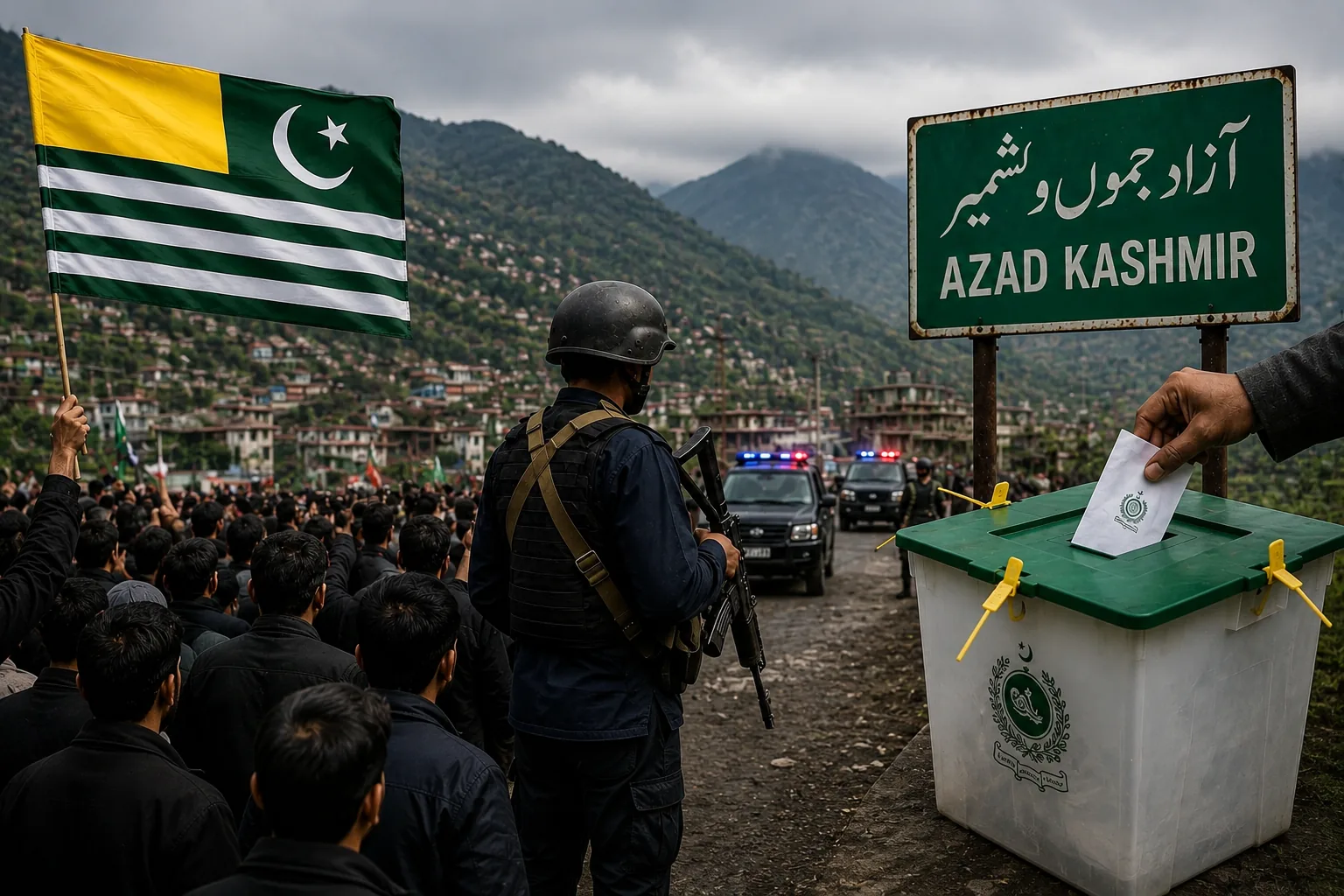
Four police officers are dead. The region’s biggest opposition party has walked away from the ballot box entirely. And in less than three weeks, close to 3.8 million voters in Azad Kashmir will still be asked to show up and vote anyway.
The Azad Kashmir election, set for July 27, 2026, has turned into something far messier than a routine assembly race. There’s a PTI boycott, a deadly clash outside a Rawalakot hospital, and a legal fight over a party symbol that the courts won’t even touch before polling day. Here’s where things actually stand, updated as of this week.
Azad Kashmir Election 2026: Key Facts at a Glance
| Detail | Information |
| Polling Date | July 27, 2026 |
| Assembly Seats | 45 directly elected + 8 reserved seats |
| Total Candidates | 852 (final list, after over 320 withdrawals) |
| Registered Voters | 3,804,385, up from 3,220,546 in 2021 |
| Major Contest | PPP vs PML-N vs IPP (PTI boycotting) |
| Key Flashpoint | JAAC unrest, Rawalakot hospital clash, 4 police killed |
| Election Body | Azad Jammu and Kashmir Election Commission (AJKEC) |
| 2021 Winner | Pakistan Tehreek-e-Insaf (PTI) |
Why PTI Boycotted the Azad Kashmir Election
On July 2, PTI announced it would sit this one out, calling it a matter of principle rather than strategy. The decision traces back to weeks of unrest in Rawalakot, where the Joint Awami Action Committee (JAAC) had been holding a sit-in outside a military hospital over a set of public demands. The AJK government banned JAAC under anti-terrorism laws, and shortly after, a violent clash left four police officers dead and roughly twenty injured. Police say armed JAAC members opened fire first. JAAC tells it differently, claiming security forces fired into the crowd after the area’s power was cut.
PTI leaned on that bloodshed, plus arrests of political workers, media restrictions, and disrupted supply lines from Punjab, to argue the process no longer had any credibility left. The party pulled its parliamentary board out of the race and demanded the schedule be revised until AJK’s political crisis actually gets resolved.
Could PTI Still Return to the Race?
Politics rarely stays settled for long, and this is no exception. Four days after the boycott, PTI chairman Gohar Ali Khan told reporters the party could reconsider “if a free and conducive environment” is restored: no arrests, no crackdowns, real movement on JAAC’s demands. Whether that happens before July 27 is anyone’s guess.
There’s also a legal wrinkle nobody’s talking about enough. The AJK High Court had restored PTI’s registration and its bat symbol, only for the Election Commission to challenge that in the Supreme Court. The hearing got deferred on July 3, and with the court now on recess until October 7, this case simply isn’t getting resolved before people vote, according to The Express Tribune. So PTI is out for now, but calling it a done deal would be premature.
Candidates and Party Symbols
With PTI sidelined, the Election Commission settled on a final list of 852 candidates for 45 constituencies, down from 1,225 valid nominations after more than 320 withdrew. Symbols went out to 24 registered parties.
| Party | Symbol |
| Pakistan Peoples Party (PPP) | Arrow |
| Pakistan Muslim League-Nawaz (PML-N) | Tiger |
| Istehkam-e-Pakistan Party (IPP) | Eagle |
| Jamaat-e-Islami (JI) | Balance |
| All Jammu and Kashmir Muslim Conference (AJKMC) | Horse |
| Jammu Kashmir Peoples Party (JKPP) | Sword |
Kotli has the most crowded ballot, with 135 candidates for just 6 seats, followed by Muzaffarabad (126 for 5 seats) and Poonch-Sudhnoti (126 for 7 seats). Mirpur, Bagh-Haveli, and Bhimber have thinner fields, and 126 candidates are contesting the 12 refugee constituencies alone.
The Battle for 45 Seats
Take PTI out of the equation, and this becomes a three-way fight between PPP, PML-N, and IPP, which is fielding AJK candidates for the first time since it was formed. PPP moved fastest, locking in nominees for nearly every seat with Bilawal Bhutto Zardari’s direct approval, and it’s fairly open about hoping to pick up PTI voters who now have nowhere else to go. Coming off a win in the Gilgit Baltistan Election 2026, PPP is also said to be keeping the door open for post-election cooperation with IPP and PML-N, not unlike the arrangement that followed that result.
IPP has fielded 35 candidates so far, with party president Aleem Khan personally handling ticket distribution, and former AJK prime minister Sardar Tanveer Ilyas, who defected from PPP, contesting three seats himself. It’s a smaller footprint than PPP’s, but IPP clearly isn’t treating this as a symbolic run.
The Legal Fight Behind the Bloodshed
Just days before the candidate list was finalized, the AJK Supreme Court ruled that the 12 refugee seats are constitutionally protected and can’t be scrapped without a formal amendment, closing off one major flashpoint. The same ruling made clear that protests can’t be used to delay the vote. And then, almost on cue, the deadly Rawalakot clash happened hours later. It’s hard to read that timing as coincidence, and it says a lot about how tightly the legal and political threads of this election are wound together.
At his press conference announcing the schedule back in June, Chief Election Commissioner Justice (retd) Ghulam Mustafa Mughal insisted the elections would be “free, fair and transparent,” a claim reported in detail by Dawn. Whether that holds up under the current strain is exactly what’s being tested right now.
What This Means for Voters
The voter rolls tell their own quiet story. AJK’s electorate has grown by 583,839 people since the last election in 2021, a jump most coverage of this race has glossed over. The largest constituency, LA-7 Bhimber-III, has nearly 130,000 registered voters; the smallest, LA-30 Muzaffarabad-IV, has just over 68,000.
The real questions heading into July 27 are less about numbers and more about mood: does the unrest in Rawalakot cool down in time, do PTI supporters bother showing up without their party on the ballot, and can a crowded field of PPP, PML-N, and IPP actually produce a government people trust? None of that shows up in a voter roll.
Do you think PTI’s boycott changes who wins this election, or will it barely move the needle? Share your take in the comments.
Things are moving fast on this one, so treat this as a snapshot rather than the final word. Candidate numbers, PTI’s next move, and the pending court case could all shift before July 27. We’ll keep this page updated as the picture becomes clearer. Reporting for this piece drew on Dawn, The Express Tribune, and Pakistan Today, current as of July 8, 2026.
Frequently Asked Questions
When is the Azad Kashmir election 2026?
July 27, 2026, with polling from 8am to 5pm.
Why did PTI boycott the election?
It pointed to the Rawalakot unrest and hospital clash, arrests of workers, and media restrictions as reasons the process wasn’t credible.
How many candidates are contesting?
852, in the final list issued by the Election Commission after over 320 withdrawals.
Could PTI still rejoin the election?
Chairman Gohar Ali Khan says it’s possible if a free political environment is restored, but PTI remains out as of now.
How many seats does the AJK Assembly have?
45 directly elected plus 8 reserved seats, for 53 total.
Who won the 2021 Azad Kashmir election?
PTI, which formed the government after winning a majority.
Top 10 Best Swimming Pools for Kids in Karachi for Safe Family Fun
Fastest 4G Network in Pakistan: Which Network Comes Out on Top?