
Makkah Joint Defence Agreement Explained: What Pakistan, Saudi Arabia & Turkey’s “Attack on One, All” Pact Means

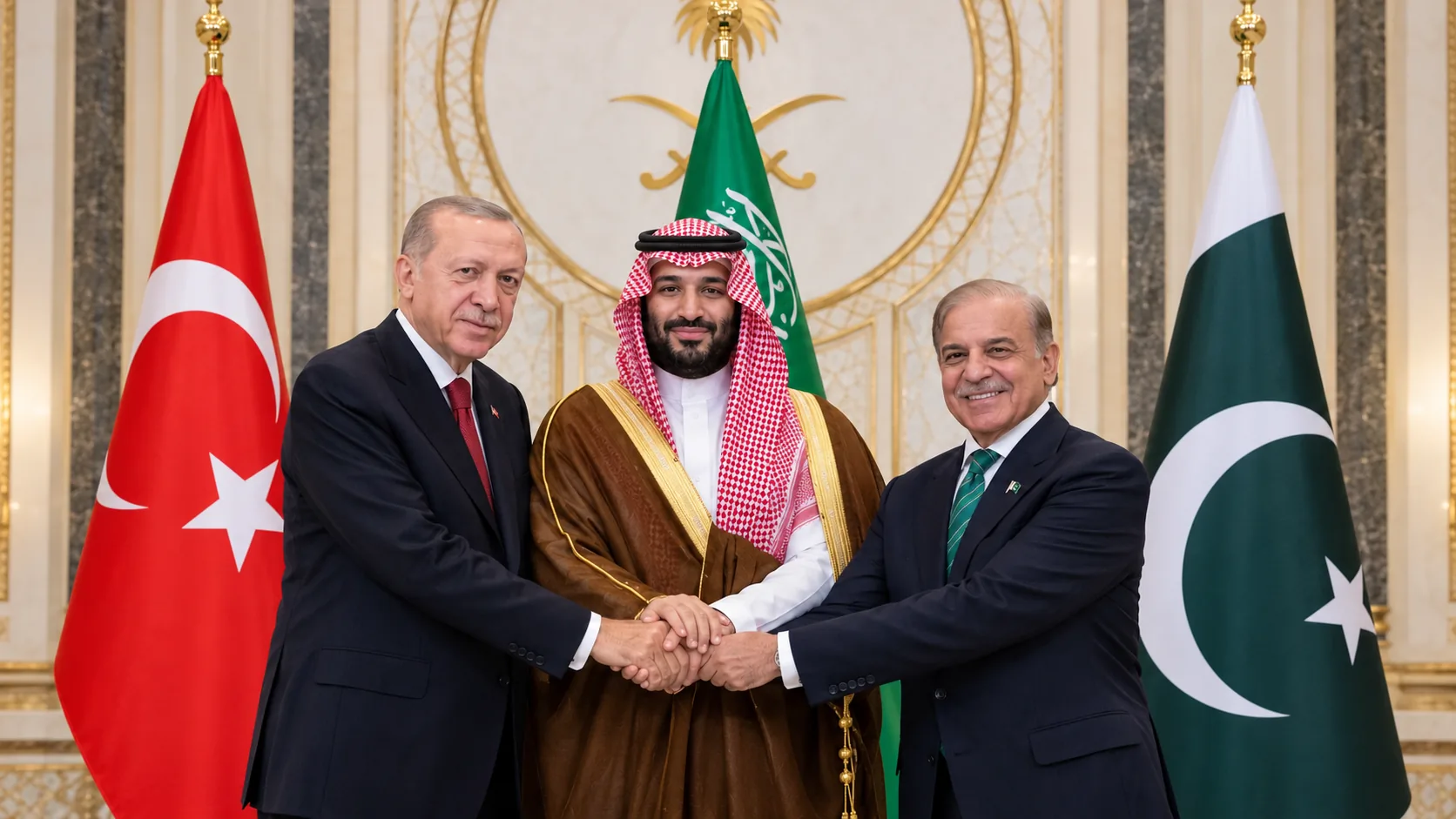
Three heads of state, one palace in Islamic history’s holiest city, and a single sentence that reshaped how three militaries relate to each other. That’s the Makkah Joint Defence Agreement in a nutshell, though the details matter more than the headline.
Quick Answer: Pakistan, Saudi Arabia, and Turkey signed the Makkah Joint Defence Agreement on August 7, 2026, agreeing that an attack on one is an attack on all three. The full legal text hasn’t been released.
Quick Facts: Makkah Joint Defence Agreement
Here’s the agreement reduced to its verified core facts, before the full breakdown below.
| Fact | Detail |
| Signed | August 7, 2026 |
| Location | Al-Safa Palace, Makkah, Saudi Arabia |
| Signatories | Crown Prince Mohammed bin Salman (Saudi Arabia), President Recep Tayyip Erdoğan (Türkiye), PM Shehbaz Sharif (Pakistan) |
| Also known as | Mecca Joint Defence Agreement / Mecca Joint Deterrence Agreement |
| Core clause | An armed attack on one signatory is regarded as an attack on all three |
| Builds on | Pakistan-Saudi Arabia Strategic Mutual Defence Agreement (bilateral) |
| Signed amid | Ongoing US-Iran war and Houthi strikes in Yemen |
| Full legal text | Not publicly released |
| Official source | Pakistan Ministry of Foreign Affairs |
What Is the Makkah Joint Defence Agreement?
It’s a trilateral defence agreement between Pakistan, Saudi Arabia, and Turkey, signed at a summit the three governments called the Makkah Al-Mukarramah Summit for Joint Defence. Pakistan’s Ministry of Foreign Affairs, in press release No. 204/2026, described it as intended “to strengthen collective deterrence against any act of aggression.”
Each country brings something distinct to the table:
- Turkey fields NATO’s second-largest standing army.
- Saudi Arabia is the largest Gulf economy and custodian of Islam’s two holiest cities.
- Pakistan is the only nuclear-armed Muslim-majority state, with an estimated 300 warheads.
What Does “Attack on One, Attack on All” Actually Mean?
The joint statement’s exact words: any armed attack against any one of the three states “shall be regarded as an attack against them all.”
What’s confirmed:
- Collective deterrence against “any act of aggression.”
- “Enhancement of all aspects of defence cooperation” between the three states.
What’s not specified anywhere in the public text:
- Troop commitments
- A joint command structure
- An automatic military-response mechanism
Erdoğan has addressed that gap directly, posting on X that the pact “does not represent any intention to build a military axis or a sectarian/religious bloc,” and isn’t “linked to nuclear ambitions or an arms race.”
Why Did Pakistan, Saudi Arabia, and Turkey Sign This Now?
Timing is hard to separate from context:
- Regional war: Signed during the ongoing US-Iran war (since February 2026), which has disrupted shipping through the Strait of Hormuz and drawn in Houthi strikes from Yemen.
- Not built overnight: Turkish Foreign Minister Hakan Fidan said the pact followed roughly a year of negotiation.
- Built on an existing pact: It extends the bilateral Pakistan-Saudi Strategic Mutual Defence Agreement, which already treated an attack on either country as an attack on both, into a trilateral one with Turkey added.
What Does the Pact Mean for Pakistan?
For Pakistan, the practical significance is less about new obligations and more about formalizing a role it already occupies informally: the security guarantor of last resort for Gulf partners, backed by its nuclear arsenal and its army’s regional reputation.
- Strategic weight: Pakistan is the only nuclear-armed state in the agreement, a fact every outlet covering this story has flagged.
- Financial relationship: Saudi Arabia has historically cushioned Pakistan’s balance-of-payments crises through central bank deposits and deferred-payment oil facilities, a dynamic this pact builds on rather than replaces.
- What it doesn’t mean: A defence commitment is not the same as an automatic troop deployment. Nothing in the public statement specifies what “collective deterrence” would look like in practice.
Is the Makkah Pact Similar to NATO?
The “attack on one, attack on all” language echoes NATO Article 5. The similarity stops at rhetoric, though, not confirmed legal structure.
| NATO Article 5 | Makkah Joint Defence Agreement | |
| Core clause | Attack on one is attack on all | Attack on one is attack on all |
| Treaty age | 75+ years | Signed August 2026 |
| Command structure | Standing, integrated | Not publicly known |
| Response obligation | Discretionary, not automatic war | Not publicly specified |
| Full legal text | Public | Not released |
Analysts calling the Makkah pact “NATO-style” are describing its language, not confirming it has NATO’s legal architecture, since the full text hasn’t been published.
Is the Makkah Agreement Aimed at Iran?
Officially, no.
- The joint statement names no country as a target.
- Turkish officials have specifically said the pact isn’t directed against Iran.
- Iran’s own Foreign Minister, Abbas Araghchi, welcomed the agreement, called for greater Muslim-majority unity, and praised Iran’s armed forces, not the reaction of a government that saw itself targeted.
The caveat: the pact was signed mid-war, with Iran fighting the US and Israel simultaneously. That timing alone will keep regional analysts reading it through an Iran lens, regardless of what the text says.
What Happens Next?
Two things remain genuinely open:
- New members: Turkish officials have suggested the door isn’t closed, but no formal expansion process has been announced.
- Implementation: How “collective deterrence” plays out in practice, joint exercises, intelligence-sharing, or something else, remains undefined in everything published so far.
This is a developing story. Chokus will update this page if the full agreement text is released or implementation details emerge.
Frequently Asked Questions
What is the Makkah Joint Defence Agreement?
A trilateral mutual-defence pact signed by Pakistan, Saudi Arabia, and Turkey on August 7, 2026, under which an armed attack on any one signatory is treated as an attack on all three.
Who signed the Makkah Joint Defence Agreement?
Saudi Crown Prince and PM Mohammed bin Salman, Turkish President Recep Tayyip Erdoğan, and Pakistani Prime Minister Shehbaz Sharif, at Al-Safa Palace in Makkah.
Is the Makkah pact similar to NATO?
Its “attack on one, attack on all” language echoes NATO’s Article 5, but the comparison is rhetorical, not legal. The Makkah agreement’s full text, including any command structure or enforcement mechanism, hasn’t been made public.
Is the Makkah agreement aimed at Iran?
The joint statement names no adversary, and Turkish officials say it isn’t directed against Iran. Iran’s foreign minister publicly welcomed the agreement rather than objecting to it.
Does the Makkah agreement guarantee military support if a member is attacked?
The public text commits to treating an attack on one as an attack on all and strengthening “collective deterrence,” but doesn’t specify troop deployments or an automatic response mechanism. What “support” means in practice hasn’t been defined publicly.
Will other countries join the Makkah defence alliance?
No formal expansion process has been announced, though officials haven’t ruled it out either.
What This Means Going Forward
This Saudi Arabia Pakistan Turkey defence pact formalizes a security relationship that, between Pakistan and Saudi Arabia at least, already existed in practice. What’s genuinely new is Turkey’s addition and the timing, a wartime signing that guarantees international scrutiny regardless of what officials say about its defensive intent. The agreement’s real weight will depend on details that aren’t public yet: implementation, command structure, and how “collective deterrence” plays out if it’s ever tested.
For more on Pakistan’s foreign policy and regional developments, follow Chokus’s ongoing Pakistan news coverage.
Written by Huzaifa Khan, who covers Pakistan’s politics and foreign policy beat for Chokus. Last updated August 10, 2026. This is a developing story based on official statements and international reporting available at time of writing; details may be updated as more of the agreement becomes public.
Top 10 Best Swimming Pools for Kids in Karachi for Safe Family Fun
Fastest 4G Network in Pakistan: Which Network Comes Out on Top?