
How Is Salary Tax Calculated in Pakistan in 2026? Slabs, Formula and Examples

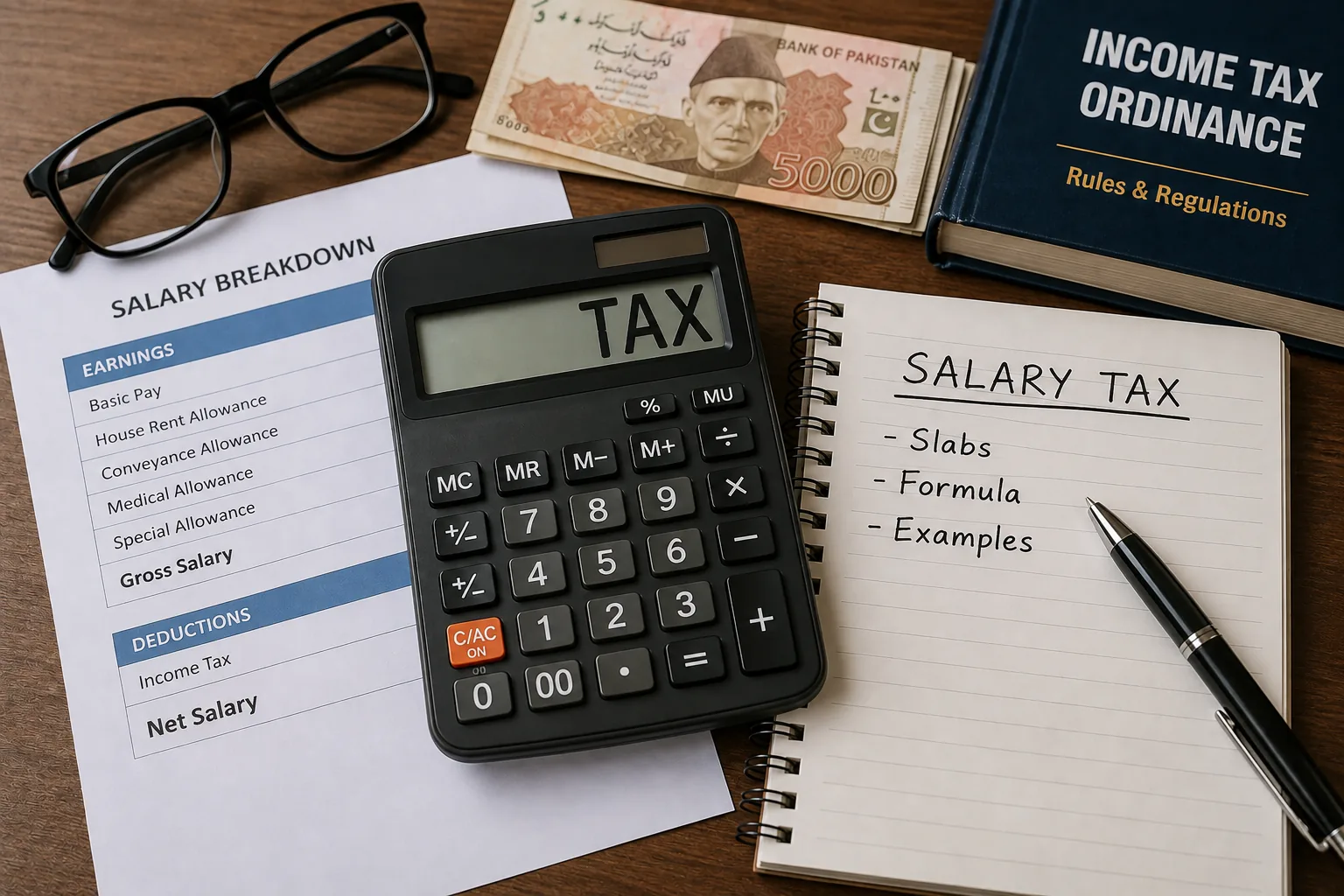
Most salary tax calculators give you a single number and stop there. They don’t show you why two people earning the same gross salary can end up with different take-home pay, or how a bonus actually gets taxed. This guide walks through the real mechanics: the formula FBR uses, the current Tax Year 2026-27 slabs, and worked examples across common salary levels so you can check the math yourself.
Quick Answer
Salary tax in Pakistan uses a progressive slab system: each slab has a fixed tax amount plus a percentage applied to income exceeding that slab’s threshold. Employers withhold this monthly under Section 149 by dividing the estimated annual liability by 12. For Tax Year 2026-27, salary up to Rs. 600,000 a year (Rs. 50,000/month) is tax-free.
How We Verified This Information
Slab rates and thresholds here are taken from FBR’s Tax Year 2026 rate card as amended by the Finance Act 2026, cross-checked against the Income Tax Ordinance 2001 for the underlying rules on allowances and deductions. Finance Act 2026 restructured salaried-individual rates from the previous year, so older calculator examples still circulating online may use outdated slabs. Last updated and calculation-checked: August 2026.
What Is Salary Tax in Pakistan?
Salary tax is the income tax charged on everything Section 12 of the Income Tax Ordinance 2001 defines as “salary”: basic pay, allowances, bonuses, commission, and most perquisites. It’s not a separate tax from income tax, it’s income tax calculated specifically on employment income, withheld by your employer every month rather than paid in a lump sum.
Salary Tax Slabs in Pakistan 2026-27
There are eight tax slabs for Tax Year 2026-27, ranging from 0% on income up to Rs. 600,000 to 35% on income above Rs. 7,000,000. Each slab applies only to the portion of income within it.
| Annual Taxable Salary | Tax Rate |
| Up to Rs. 600,000 | 0% |
| Rs. 600,000 – 1,200,000 | 1% of the amount exceeding Rs. 600,000 |
| Rs. 1,200,000 – 2,200,000 | Rs. 6,000 + 11% of the amount exceeding Rs. 1,200,000 |
| Rs. 2,200,000 – 3,200,000 | Rs. 116,000 + 20% of the amount exceeding Rs. 2,200,000 |
| Rs. 3,200,000 – 4,100,000 | Rs. 316,000 + 25% of the amount exceeding Rs. 3,200,000 |
| Rs. 4,100,000 – 5,600,000 | Rs. 541,000 + 29% of the amount exceeding Rs. 4,100,000 |
| Rs. 5,600,000 – 7,000,000 | Rs. 976,000 + 32% of the amount exceeding Rs. 5,600,000 |
| Above Rs. 7,000,000 | Rs. 1,424,000 + 35% of the amount exceeding Rs. 7,000,000 |
The Pakistan Salary Tax Formula
The core formula behind every number in the table above:
- Annual Salary = Monthly Salary × 12
- Annual Tax = Fixed Tax + (Tax Rate × Excess Amount)
- Excess Amount = Annual Taxable Salary − Lower Threshold of Your Slab
- Monthly Tax = Annual Tax ÷ 12
- Take-Home Salary = Gross Monthly Salary − Monthly Tax
Gross Salary vs Taxable Salary: What’s the Difference?
Taxable salary is always equal to or less than gross salary, never more. Here’s what separates the two:
| Gross Salary | Taxable Salary | |
| Includes | Everything you’re paid: basic, all allowances, bonus, commission | Gross salary minus legally exempt components (like qualifying medical allowance) |
| Used for | What appears as your total package or offer letter figure | What FBR actually applies the slab rates to |
The gap between the two is where real tax savings happen, entirely through correctly classifying exempt allowances, not through any special deduction.
Are Allowances and Bonuses Taxable in Pakistan?
Section 12 casts a wide net by default, most components of your pay are taxable unless a specific exemption applies:
| Component | Tax Treatment |
| Basic salary | Fully taxable, no exemptions |
| Bonus, commission, overtime | Fully taxable |
| Medical allowance (cash) | Exempt up to 10% of basic salary or Rs. 10,000/month, whichever is lower |
| House rent allowance (cash) | Fully taxable, an older exemption was removed from current rules |
| Conveyance allowance (cash) | Fully taxable, no exemption applies under current rules |
| Employer-provided accommodation (non-cash) | Valued at 45% of basic salary or fair market value, whichever is higher, and added to taxable income |
| Special/duty allowance | Exempt only if strictly for performing job duties, with proper documentation |
| Provident fund (employer contribution, recognized fund) | Generally exempt within statutory limits |
Expert Tip: Both house rent and conveyance allowances used to carry partial exemptions under older rules. Current FBR guidance is explicit that neither qualifies anymore, both are added in full to taxable salary. If you’re using an older calculation guide as a reference, this is the detail most likely to be outdated.
Salary Tax Calculation Examples
Here’s the formula applied to real monthly salaries, using Tax Year 2026-27 slabs:
Example 1: Rs. 100,000 Monthly Salary
Annual salary: Rs. 1,200,000. This sits at the top of the 1% bracket. Annual tax: 1% × (1,200,000 − 600,000) = Rs. 6,000. Monthly tax: Rs. 500. Take-home: approximately Rs. 99,500/month.
Example 2: Rs. 150,000 Monthly Salary
Annual salary: Rs. 1,800,000, in the 11% bracket. Annual tax: 6,000 + 11% × (1,800,000 − 1,200,000) = Rs. 72,000. Monthly tax: Rs. 6,000. Take-home: approximately Rs. 144,000/month.
Example 3: Rs. 200,000 Monthly Salary
Annual salary: Rs. 2,400,000, in the 20% bracket. Annual tax: 116,000 + 20% × (2,400,000 − 2,200,000) = Rs. 156,000. Monthly tax: Rs. 13,000. Take-home: approximately Rs. 187,000/month.
Example 4: Rs. 300,000 Monthly Salary
Annual salary: Rs. 3,600,000, in the 25% bracket. Annual tax: 316,000 + 25% × (3,600,000 − 3,200,000) = Rs. 416,000. Monthly tax: Rs. 34,667. Take-home: approximately Rs. 265,333/month.
Example 5: How a Bonus Changes the Math
Take Example 3’s earner, now add a Rs. 200,000 annual bonus. New annual salary: Rs. 2,600,000, still in the 20% bracket. New annual tax: 116,000 + 20% × (2,600,000 − 2,200,000) = Rs. 196,000, up from Rs. 156,000. The bonus cost exactly Rs. 40,000 in extra tax, its full value taxed at the 20% marginal rate.
Example 6: Gross vs Taxable Salary in Practice
An employee earns Rs. 250,000/month (Rs. 3,000,000/year), with Rs. 20,000/month exempt as medical allowance. Taxable salary: Rs. 2,760,000/year. Tax on full gross would be Rs. 276,000; tax on the correct taxable figure is Rs. 228,000, a Rs. 48,000 difference from proper allowance classification.
How Employers Deduct Salary Tax Under Section 149
Your employer doesn’t wait until year-end to collect your tax. Under Section 149, they estimate your annual tax liability at the start of the year and withhold roughly one-twelfth of it every month. If your salary, bonus, or allowances change mid-year, the estimate gets revised, which is why your monthly deduction can shift even without a raise. The amount withheld should appear as a separate line on your payslip each month.
Key Takeaways: Employer Withholding
- Estimated monthly deduction can differ from your true final liability if your income changes during the year
- A mid-year bonus is typically taxed by adjusting the remaining months’ withholding, not as a one-time flat deduction
- Reconciliation happens automatically through employer withholding; salaried individuals still file a return separately if required
Common Mistakes When Calculating Salary Tax
- Using last year’s slabs instead of the current Tax Year 2026-27 rates
- Applying the tax rate to gross salary instead of taxable salary after exemptions
- Assuming house rent allowance is exempt like medical allowance, it isn’t
- Forgetting that a bonus is taxed at your marginal rate, not your average rate
- Dividing the wrong number by 12, using gross annual salary instead of annual tax to estimate the monthly deduction
FAQs
How is salary tax calculated in Pakistan?
Your annual taxable salary is matched to its FBR slab, then the slab’s fixed tax amount plus its percentage rate on the excess over the threshold gives your annual tax. Divide by 12 for the monthly deduction.
How much salary is tax-free in Pakistan in 2026-27?
Rs. 600,000 a year, or Rs. 50,000 a month, is completely tax-free under the current slabs.
What are the latest salary tax slabs in Pakistan?
Eight brackets ranging from 0% up to Rs. 600,000, to 35% above Rs. 7,000,000, detailed in the table above under Tax Year 2026-27 rates.
Is salary tax calculated on gross salary or basic salary?
Neither exactly, it’s calculated on taxable salary, which is your gross salary minus any legally exempt allowances like a qualifying medical allowance.
What is the salary tax formula in Pakistan?
Annual Tax = Fixed Tax for your slab + (Tax Rate × the amount your salary exceeds that slab’s threshold).
How is monthly salary tax calculated?
Calculate your annual tax first using the slab formula, then divide by 12. Employers withhold this monthly estimate under Section 149.
How much tax is deducted from a Rs. 100,000 salary?
Rs. 500 a month (Rs. 6,000 annually), since Rs. 1,200,000 a year sits at the top of the 1% bracket.
How much tax is deducted from a Rs. 200,000 salary?
Rs. 13,000 a month (Rs. 156,000 annually), based on Rs. 2,400,000 annual income falling in the 20% bracket.
How much tax is deducted from a Rs. 300,000 salary?
Rs. 34,667 a month (Rs. 416,000 annually), based on Rs. 3,600,000 annual income falling in the 25% bracket.
Are allowances included in taxable salary?
Most are. Bonuses, commission, and house rent allowance are fully taxable. Medical allowance is exempt up to 10% of basic salary or Rs. 10,000/month, whichever is lower.
Is a bonus taxable in Pakistan?
Yes, fully. A bonus is added to your annual salary and taxed at whatever marginal rate that pushes you to, not at a separate flat rate.
How can I calculate my take-home salary after tax?
Subtract your monthly tax deduction (annual tax ÷ 12) from your gross monthly salary. The examples above show this for several salary levels.
Why does my employer deduct tax from my salary every month?
Section 149 of the Income Tax Ordinance requires employers to withhold tax at source, spreading your estimated annual liability across 12 monthly deductions instead of one year-end payment.
What is the difference between annual salary tax and monthly salary tax?
Annual salary tax is your total yearly liability calculated from the slab formula. Monthly salary tax is that figure divided by 12, which is what actually gets withheld from each paycheck.
Can salaried employees claim tax credits in Pakistan?
Certain credits exist for specific circumstances, but they’re a separate mechanism from the salary calculation covered here and are typically applied at return-filing time rather than in the monthly withholding formula.
Getting the Math Right, Not Just the Number
A calculator can hand you a figure in seconds. What it usually can’t tell you is why that figure is what it is, whether your allowances are correctly classified, or how a bonus will actually move your tax bill. Once you understand the fixed-tax-plus-excess formula and which parts of your pay are genuinely exempt, you can check any calculator’s output yourself, or catch it when it’s wrong.
Key Takeaways
- Tax-free threshold: Rs. 600,000/year (Rs. 50,000/month)
- Formula: Fixed Tax + (Rate × Excess Over Threshold)
- Medical allowance exemption: up to 10% of basic salary or Rs. 10,000/month
- House rent allowance (cash) is fully taxable, unlike medical allowance
- A bonus is taxed at your marginal rate, not averaged into your regular salary
For the full slab breakdown and how they changed this year, see our guide to income tax slabs for Tax Year 2026-27, and if you’re unsure whether you need to file a return at all, check our filer vs non-filer guide.
Source: FBR Tax Year 2026 Rate Card, Income Tax Ordinance 2001, Finance Act 2026 | Last Verified: August 12, 2026 | Est. reading time: 8 minutes

Top 10 Best Swimming Pools for Kids in Karachi for Safe Family Fun

Fastest 4G Network in Pakistan: Which Network Comes Out on Top?