
Rupee Appreciation Effect on Imports Pakistan

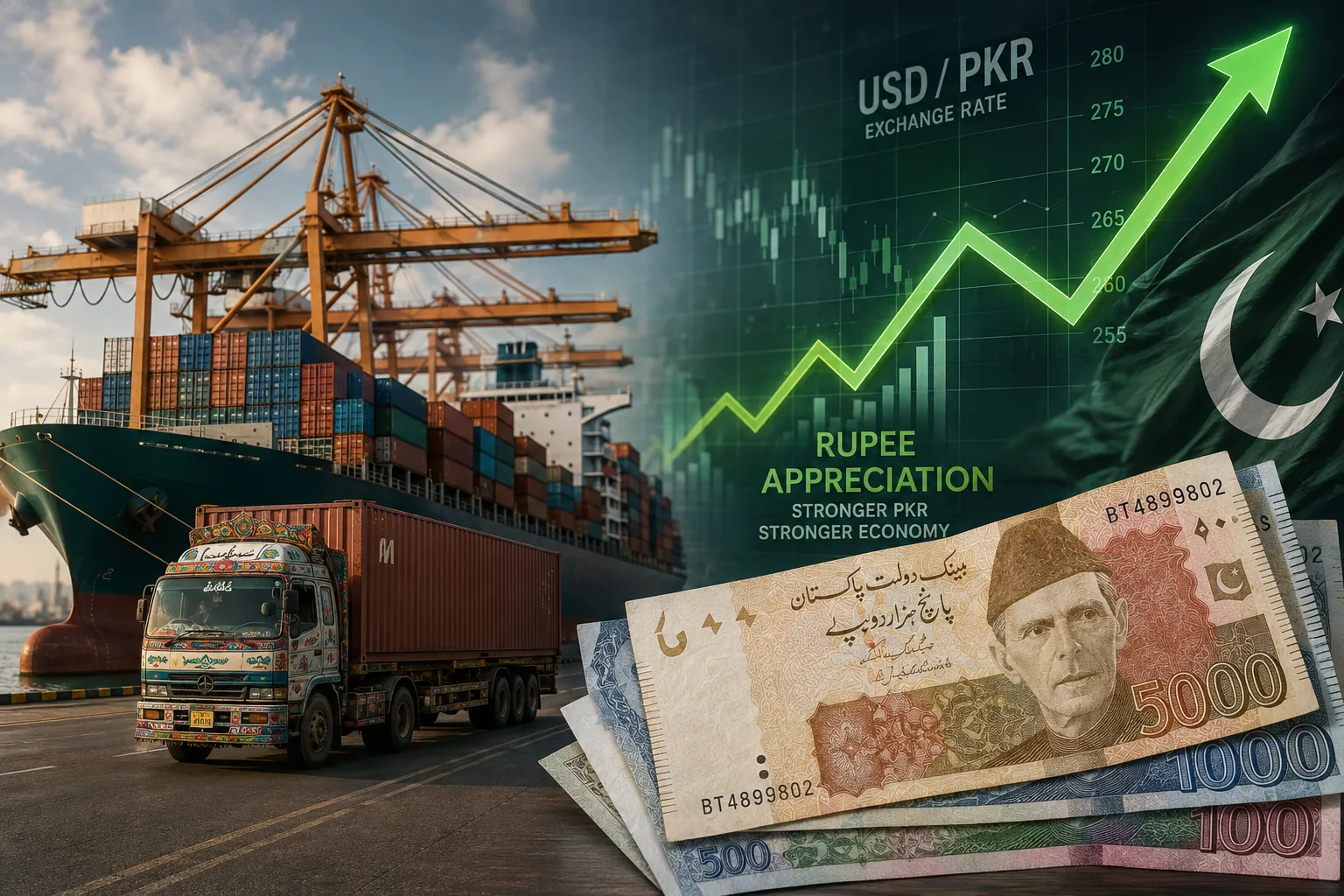
Most coverage of Pakistan’s “strong rupee” story stops at the exchange rate and misses a contradiction: the currency is genuinely stronger, yet the trade deficit widened anyway. This guide breaks down what’s actually driving PKR higher, how that plays out differently across fuel, machinery, and consumer imports, and why the trade gap grew despite it.
Quick Answer
The rupee appreciation effect on imports Pakistan should theoretically be lower import costs. Instead, Pakistan’s trade deficit widened to $32.2 billion in FY2026 from $27.0 billion, because import volumes grew faster than the exchange rate could offset. The rupee closed at roughly 277.81 against the dollar in late July 2026, its strongest level in 19 months.
How We Verified This Information
Every figure here is drawn from Pakistan’s official Economic Survey FY2025-26, SBP’s reserve reports, and the Finance Division’s Monthly Economic Update, cross-checked against independent reporting rather than a single outlet. Where a widely circulated claim didn’t match the official data, specifically claims that the trade deficit narrowed this year, we’ve gone with the government’s own figures instead, which clearly show a widening deficit.
Quick Reference: The Numbers That Matter
Here’s the full picture at a glance before we break down what’s driving each number:
| Metric | Figure |
| USD/PKR (late July 2026) | ~277.81, a 19-month high |
| GDP growth, FY2026 | 3.7%, fastest in four years |
| Per capita income | $1,901, up from $1,751 |
| Trade deficit (goods & services), FY2026 | $32.2 billion, widened from $27.0 billion |
| Imports | $69.6 billion, up from $64.5 billion |
| Exports | $37.4 billion, roughly flat |
| Remittances (Jul-May FY2026) | $38.1 billion, up 9.2% |
| Current account | $255 million surplus, Jul-May FY2026 |
Why Is the Rupee Gaining Against the Dollar?
Three forces are doing most of the work.
Record Remittances
Overseas Pakistani workers sent home $38.1 billion between July and May of FY2026, up 9.2% year-on-year, with May alone setting a record at $4.3 billion. Remittances are one of the largest sources of dollar inflows into Pakistan’s banking system, and sustained growth here directly supports the rupee.
A Current Account Surplus
Pakistan ran a current account surplus of $255 million during Jul-May FY2026. A surplus means more foreign currency is entering the country than leaving it, which is a straightforward tailwind for the local currency.
Rebuilding Foreign Exchange Reserves
The State Bank’s reserves surpassed $18 billion by the end of June 2026, and total liquid reserves touched nearly $24 billion in early July before settling closer to $22.4 billion by late July, as external debt repayments were made. The SBP Governor has projected reserves reaching $20.2 billion by December 2026. Rebuilding reserves from a low base gives the central bank more room to manage volatility, which supports currency stability.
Expert Tip: A stronger rupee genuinely helps anyone paying dollar-denominated bills, external debt servicing, imported medicine, and raw material costs for manufacturers. But it doesn’t automatically fix the trade deficit, because Pakistan’s import bill is driven as much by how fast the economy is growing as it is by the exchange rate.
So Why Did the Trade Deficit Widen Anyway?
This is the most coverage of the “strong rupee” story skips.
| Metric | FY2025 | FY2026 | Change |
| Imports (goods & services) | $64.5 billion | $69.6 billion | +7.9% |
| Exports (goods & services) | $37.5 billion | $37.4 billion | roughly flat |
| Trade deficit | $27.0 billion | $32.2 billion | widened |
Pakistan’s 3.7% GDP growth meant businesses bought more machinery, raw materials, and fuel to support that growth. A cheaper dollar made each unit cheaper, but the country bought enough additional units that the total import bill still rose. Exports, meanwhile, stayed almost exactly flat.
Rupee Appreciation Effect on Imports Pakistan, by Category
Not every import category benefits equally from a stronger rupee.
Fuel and Petroleum Imports
Pakistan imports the overwhelming majority of its petroleum needs, so a stronger rupee does reduce the rupee cost of every barrel. This year, that benefit was largely offset by international crude prices spiking due to the Middle East conflict, which is a separate factor entirely from the exchange rate.
Machinery and Industrial Raw Materials
This is where GDP growth shows up most directly. Faster industrial and services growth means more imported machinery and inputs, and a stronger rupee makes each shipment marginally cheaper, but rising volume can still push the total bill higher.
Consumer Goods and Food
Cheaper imported consumer goods and food items are one of the more directly felt benefits for ordinary households, since a stronger rupee flows through to import-heavy retail categories faster than to industrial inputs.A stronger rupee doesn’t always mean cheaper prices. Learn why in our Inflation in Pakistan 2026 guide.
What This Means If You’re an Exporter
A stronger rupee is a genuine headache for exporters, since it makes Pakistani goods marginally more expensive for foreign buyers in dollar terms, squeezing already-thin margins in competitive sectors like textiles. It’s the classic tradeoff: what helps importers works against exporters at the same time.
Frequently Asked Questions:
What is the rupee appreciation effect on imports in Pakistan?
In theory, a stronger rupee makes imports cheaper. In FY2026, Pakistan’s total import bill still rose from $64.5 billion to $69.6 billion, because economic growth drove higher import volumes that outweighed the exchange rate benefit.
Why is PKR gaining against the dollar in 2026?
Record remittances of $38.1 billion (Jul-May), a $255 million current account surplus, and foreign exchange reserves rebuilding past $18 billion are the three main drivers cited by the State Bank of Pakistan and Finance Division.
Does rupee appreciation reduce Pakistan’s trade deficit?
Not automatically. Despite the rupee’s gains, Pakistan’s trade deficit widened to $32.2 billion in FY2026 from $27.0 billion, because import volumes grew faster than the exchange rate could offset, while exports stayed roughly flat.
How does rupee appreciation affect inflation in Pakistan?
A stronger rupee generally eases imported inflation by making imported goods and raw materials cheaper. Pakistan’s average inflation for FY2026 stood at 6.7%, though it briefly rose into double digits during April and May due to Middle East conflict-related pressures on fuel prices.
What is the effect of a strong rupee on Pakistani exporters?
It’s generally negative for competitiveness, since Pakistani goods become relatively more expensive for foreign buyers in dollar terms. This adds pressure on already tight margins in export-heavy sectors like textiles.
PKR kyun gain kar raha hai 2026 mein?
Record remittances ($38.1 billion), current account surplus, aur forex reserves ka $18 billion se upar rebuild hona, ye teen wajah SBP aur Finance Division ne bataye hain rupee ki strength ke peeche.
Rupee appreciation se imports par kya asar hota hai Pakistan mein?
Nazariyati taur pe imports sasti honi chahiye, lekin FY2026 mein Pakistan ka import bill $64.5 billion se badh kar $69.6 billion ho gaya, kyunki economic growth ki wajah se import volume itna zyada badha ke exchange-rate ka fayda cover nahi ho saka.
The Rupee Is Healthier, But the Trade Gap Isn’t Closing
The rupee’s strength this year is real, built on genuine fundamentals rather than a temporary fluke. It just hasn’t been enough to fix the trade deficit, because Pakistan’s growing economy is importing faster than any exchange rate can offset.
Key Takeaways
- PKR at a 19-month high (~277.81), driven by remittances, current account surplus, and reserve rebuilding
- Trade deficit widened to $32.2 billion despite rupee strength, because import volumes outgrew the exchange rate benefit
- GDP growth of 3.7%, the fastest in four years, is the main reason import demand rose
- Fuel, machinery, and consumer goods each benefit differently from rupee appreciation
- Exporters face margin pressure as the flip side of a stronger currency
For more on how this year’s economic shifts are affecting households and businesses, see our coverage of Pakistan’s record IT exports, or browse our Economy section for further updates.
Written by Team Chokus | Source: Pakistan Economic Survey FY2025-26, State Bank of Pakistan, Finance Division | Last Verified: July 30, 2026 | Est. reading time: 7 minutes

Top 10 Best Swimming Pools for Kids in Karachi for Safe Family Fun

Fastest 4G Network in Pakistan: Which Network Comes Out on Top?