
Pakistan AI Data Center: Karachi Tackles the $800M Compute Bill

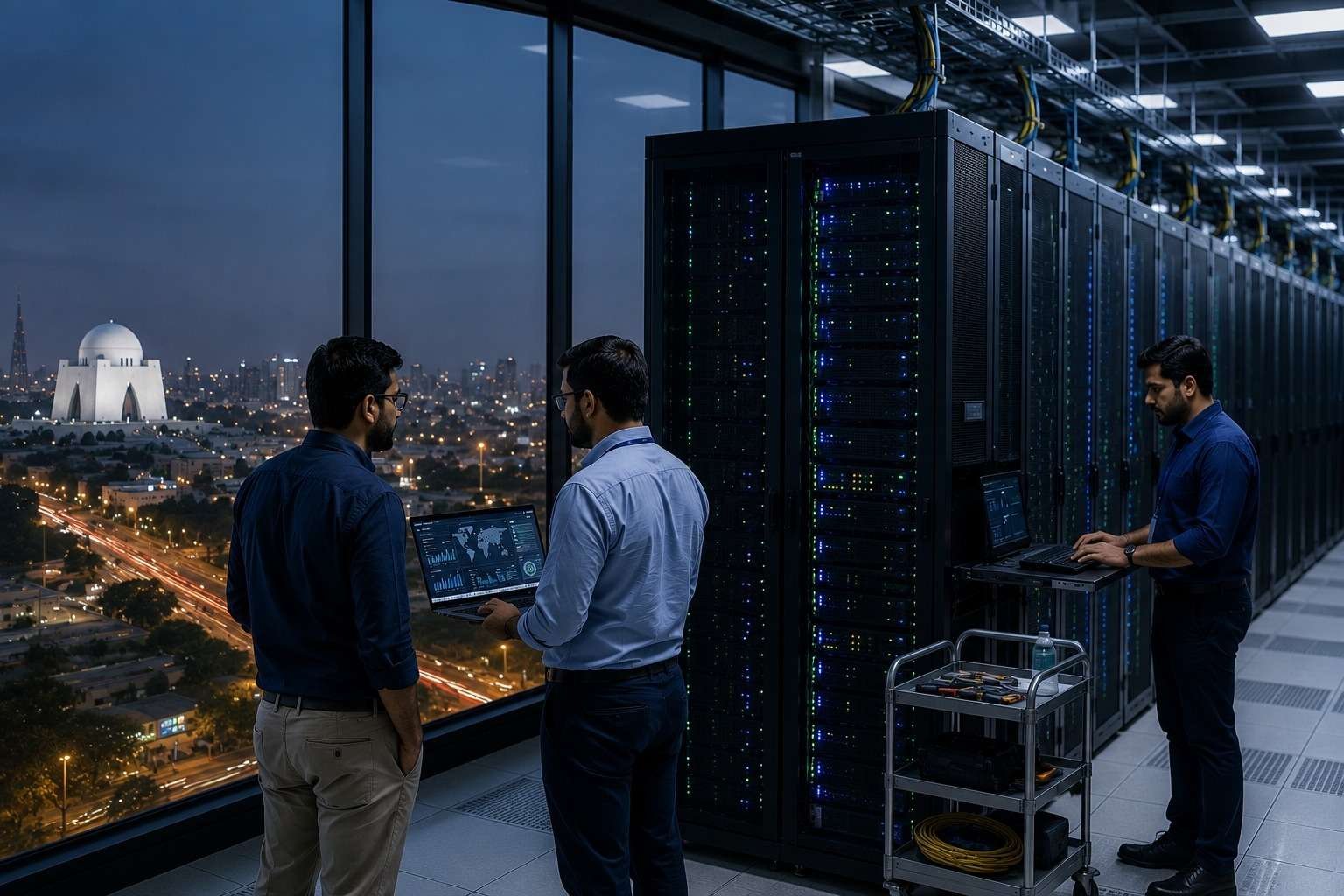
Pakistan’s AI data center capacity is so limited that the country spends an estimated $700 to $800 million a year renting computing power from foreign cloud providers, money that leaves before a single Pakistani startup, bank, or government office benefits from it. That started to change in June 2026, when Karachi’s Quantum Global Data Centre (QGDC) broke ground on a $230 million Tier III facility, with total investment expected to reach $600 million by 2030.
This is Pakistan’s most serious attempt yet to build AI compute capacity at home instead of renting it from abroad, and it isn’t only a Karachi story. It’s a national one, about jobs, digital independence, and whether Pakistan controls its own AI future or keeps paying rent for someone else’s.
Quick Facts: Pakistan’s New AI Data Center at a Glance
Here’s the entire QGDC project reduced to its core numbers, so you can see the scale of the bet at a glance before reading the full breakdown below.
| Fact | Detail |
| Project | Quantum Global Data Centre (QGDC), Karachi Technopolis |
| Initial investment | $230 million |
| Total planned investment | Up to $600 million by 2030 |
| Facility type | Tier III data center |
| Technology partner | Huawei Pakistan |
| Target launch | 2027 |
| Problem it addresses | Pakistan’s $700 to $800 million a year foreign AI computing spending |
What Is a Tier III Data Center, and Why Does It Matter for Pakistan?
A Tier III data center uses redundant power, cooling, and network systems to guarantee around 99.982% uptime, so it can undergo maintenance or absorb a component failure without ever going offline. Most of Pakistan’s existing 20 to 25 data centers don’t meet this standard. Since a Pakistan AI data center at Tier III level can host sensitive workloads reliably, banks, hospitals, universities, and government departments could finally run AI systems inside the country, under Pakistani law, instead of on servers abroad.
Pakistan AI Data Center: Why Is Karachi Building One Now?
Pakistan’s total installed data center IT load currently sits at just 23.53MW, but industry estimates project demand will more than double to 53.30MW by 2030 as AI adoption grows across banking, healthcare, education, and government services. Every unit of that demand not met locally gets routed abroad, at a real financial cost.
QGDC Chairman Danish Iqbal summed up the urgency at Karachi’s Q Summit in June 2026, noting that Pakistan has “not even started” with AI adoption, yet already pays $700 to $800 million a year for foreign compute. Because domestic capacity hasn’t kept pace, that bill only grows as AI use deepens across the economy.
How Much Is This Pakistan AI Data Center Worth?
The QGDC facility isn’t a standalone data center. It’s the anchor of a bigger digital infrastructure project in Karachi’s Korangi Industrial Area, and it draws power from Gul Ahmed Energy Group’s existing captive power plant rather than the national grid alone.
| Detail | Figure / Status |
| Initial investment | $230 million |
| Projected total investment (3 to 4 years) | Up to $600 million |
| Facility classification | Tier III |
| Power source | 136MW captive power plant (Gul Ahmed Energy) |
| Claimed IT capacity | 80 to 100MW (figures disputed) |
| Technology partner | Huawei Pakistan |
| Target operational date | 2027 |
| Location | Karachi Technopolis, Korangi Industrial Area |
| Pending approval | Tax exemption from the Special Technology Zones Authority |
Why Don’t the Capacity Numbers Match?
Data Center Dynamics, the trade publication that tracks data center projects worldwide, flagged this exact gap: QGDC’s own site lists 100MW of capacity, while the International Association of Science Parks puts the figure at 80MW. QGDC hasn’t clarified which number is accurate, and the $230 million initial tranche is only the opening phase of a much larger plan.
How Does This Fit Into Sindh’s Wider Push?
Around the same time, Sindh officials announced plans for the Sindh IT Tower and positioned Karachi as the country’s primary AI hub through the Karachi Next AI & Innovation Summit. Separately, Data Vault Pakistan already claims the title of the country’s first AI-focused, solar-powered data center, while Telenor Pakistan has launched a locally hosted AI cloud in partnership with Data Vault. None of these projects were planned together on paper, yet they’re landing within months of each other, which is what makes this feel like a real shift in Pakistan’s digital infrastructure rather than one company’s announcement. Chokus tracks this story in more depth in its technology coverage.
How Does Huawei Fit Into the Pakistan AI Data Center Plan?
Huawei Pakistan is QGDC’s technology partner, supplying the Huawei Cloud Stack framework so Pakistani banks, telecoms, and government bodies can eventually run AI and cloud workloads locally instead of through foreign providers, while keeping control over their own data.
What Exactly Does Huawei Bring to the Project?
The collaboration covers design, technical planning, and rollout of both the data center and an adjacent science park. Huawei’s own national cloud program states that its Cloud Stack framework already supports government and financial-sector clients in more than 170 countries, which gives QGDC a tested blueprint rather than an experimental one.
Why Does Local Cloud Infrastructure Matter for Pakistan?
Most current Pakistan cloud computing usage still depends on foreign hyperscalers. A locally built Huawei Pakistan data center framework would keep sensitive data, financial records, health data, and government files inside the country’s own jurisdiction, instead of on servers governed by another country’s laws. Whether Pakistani banks and regulators actually trust a locally hosted system with that data from day one is a separate question, and probably the one that decides how fast adoption really moves.
Who Benefits From This Pakistan AI Data Center Beyond Karachi?
Short answer: This isn’t just a Karachi story. Here’s who actually stands to gain if the project delivers.
- Freelancers and IT exporters: Pakistan’s IT exports crossed $2.97 billion in eight months of FY2026, with freelancers contributing 25% of that figure. Local AI infrastructure means cheaper, faster compute access for developers building AI products anywhere in the country, not only Karachi.
- Startups nationwide: Founders currently pay foreign cloud bills in dollars, at a time when the rupee is under pressure. A domestic AI data center in Pakistan in 2026 would ease that foreign-exchange drain for startups in Lahore, Islamabad, Peshawar, or Multan, not only in Sindh. It fits the broader momentum Chokus covered in Pakistan’s growing startup scene.
- Government digitization: Pakistan’s National AI Advancement Initiative has already announced plans to train roughly one million people in AI-related skills over the next three years, building on other national upskilling efforts already underway. That workforce still needs local infrastructure to actually build on.
- Universities and researchers: High-performance computing access for AI research has historically required partnerships with foreign institutions. Local Tier III data center in Pakistan capacity would open the door for Pakistani universities to run larger models domestically.
What Could Go Wrong? The Roadblocks Nobody’s Talking About
Short answer: Three real risks could still delay this project past 2027. Here’s each one.
- Power reliability: Even with a dedicated 136MW captive plant, Pakistan’s broader grid still struggles with load-shedding, and data centers are extremely power-hungry by design.
- Water usage concerns: Data centers require substantial water for cooling. Running large AI facilities in a country already facing water stress makes sense only if recycled-water cooling systems are strictly enforced.
- Regulatory delays: The Karachi Technopolis project’s tax-exemption status from the Special Technology Zones Authority is still pending, and exact IT capacity figures remain inconsistent between QGDC’s own claims and independent industry sources.
How Does Pakistan’s Investment Compare Globally?
Regional peers such as the UAE and Saudi Arabia have already committed far larger sums to sovereign AI infrastructure, so Pakistan’s $600 million plan is comparatively modest.
Does Pakistan’s Track Record Inspire Confidence?
Pakistan’s own track record with large infrastructure timelines is mixed. Programs like Digital Pakistan and the national 5G rollout both slipped well past their original target dates, so a degree of caution about the 2027 date isn’t unreasonable. That said, this marks a genuine first step rather than another announcement that goes nowhere.
Pakistan’s AI Infrastructure at a Glance
Beyond QGDC, several other projects are moving at roughly the same time, which is why this feels like a coordinated push rather than one isolated announcement.
| Initiative | Location | Status (as of July 2026) |
| Quantum Global Data Centre (QGDC) | Karachi Technopolis | Under construction, targeting 2027 |
| Sindh IT Tower | Karachi | Announced, launch pending |
| Data Vault Pakistan | Karachi | First AI-focused data center, operational |
| Telenor AI Cloud | Pakistan-wide (hosted in-country) | Operational |
| National AI Advancement Initiative | Nationwide | Training rollout in progress |
Final Word
Karachi’s $600 million bet is the first real test case for Pakistan’s AI data center push, a genuine move toward owning the country’s AI future rather than renting it. If executed well, it could turn an $800-million annual outflow into a homegrown industry that benefits freelancers in Lahore, startups in Islamabad, and researchers in Peshawar just as much as it benefits Karachi itself. Even so, the real test isn’t the announcement. It’s whether power, water, and regulatory approvals can keep pace with the ambition.
Do you think Pakistan’s AI ambitions can outpace its power and water constraints, or will this Pakistan AI data center push turn into one more announcement that stalls at the groundbreaking? Share your take in the comments.
Written by the Chokus.pk team. Last updated July 15, 2026, while QGDC’s tax-exemption status remains pending with the Special Technology Zones Authority, so figures here may shift as that approval comes through.
Frequently Asked Questions
How much does Pakistan spend on foreign AI compute every year?
Pakistan spends an estimated $700 to $800 million annually renting AI computing power from foreign cloud providers, according to QGDC Chairman Danish Iqbal, a figure expected to rise as AI adoption grows.
What is the Quantum Global Data Centre (QGDC) in Karachi?
QGDC is a Gul Ahmed Energy Group venture building one of Pakistan’s largest planned Tier III data centers in Karachi Technopolis, with an initial $230 million investment set to scale toward $600 million, in partnership with Huawei Pakistan.
Is this Pakistan AI data center only for Karachi?
Not really. The building itself is in Karachi, but QGDC designed it to serve banks, government agencies, universities, and startups anywhere in Pakistan by cutting the country’s overall dependence on foreign cloud infrastructure.
When will Pakistan’s new AI data center be operational?
QGDC’s Karachi facility is targeting commercial operations by 2027, pending final regulatory approvals from Pakistan’s Special Technology Zones Authority.
Why does Pakistan need its own AI data centers instead of using foreign cloud services?
Local data centers keep sensitive data inside Pakistan’s jurisdiction, reduce foreign-exchange outflow, support compliance and data-privacy requirements, and give local startups and researchers faster, more affordable access to compute.
Who is funding the Karachi Technopolis project?
Gul Ahmed Energy Group. The company is funding and developing the project itself, drawing on its existing captive power plant, while it still waits on a Special Technology Zones Authority tax exemption.
What could delay Pakistan’s AI data center plans?
Three things, mainly: power grid limitations, water availability for cooling, and the pending tax-exemption decision. Any one of them could push the 2027 target back.
How does Pakistan’s current data center capacity compare to future demand?
Pakistan’s installed data center IT load stands at roughly 23.53MW today, but industry estimates project demand will rise to 53.30MW by 2030, meaning current capacity covers less than half of expected need.

Top 10 Best Swimming Pools for Kids in Karachi for Safe Family Fun

Fastest 4G Network in Pakistan: Which Network Comes Out on Top?