
How Is Electricity Bill Calculated in Pakistan? Slabs, Taxes, FPA and the Exact Formula (2026)

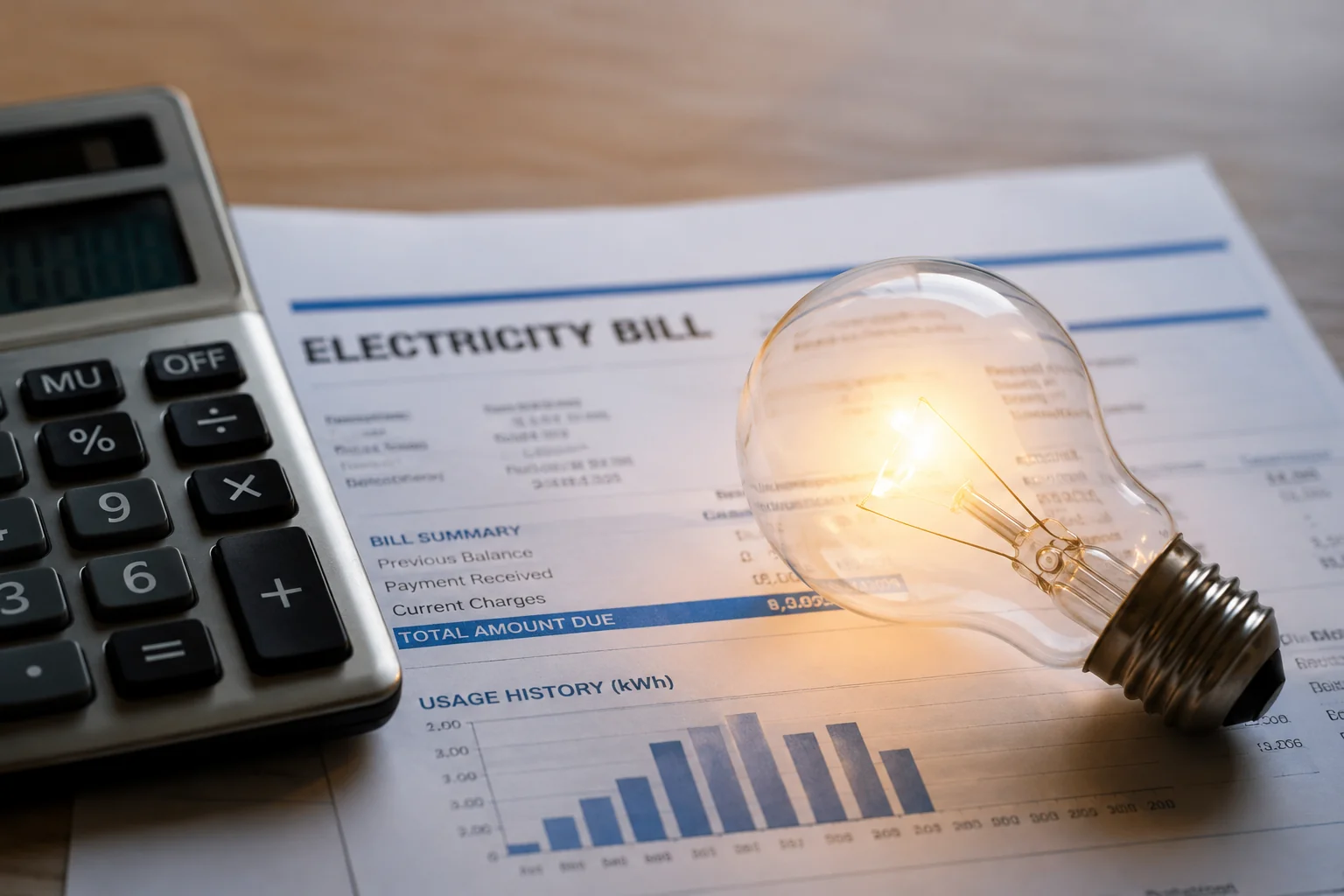
How electricity bill is calculated in Pakistan comes down to more than units multiplied by a rate. Several separate charges stack on top of your energy consumption before you reach the final payable amount. Once you know what each one is, checking your bill for errors and predicting the next one becomes much easier.
Quick Answer
Your bill starts with consumed units, the difference between current and previous meter readings. These are billed slab by slab based on protected or unprotected status, then NEPRA adds fixed charges, FPA, QTA, taxes, and a TV fee for the final amount.
What Are the Main Charges on a Pakistan Electricity Bill?
Understanding how an electricity bill is calculated in Pakistan starts with recognising it is built in five layers, not one. Energy charges cover the units you consumed, priced slab by slab. Fixed charges apply monthly based on your sanctioned load in kW, regardless of usage. Adjustments include FPA and QTA, which change monthly and quarterly. Taxes cover GST, electricity duty, and the TV fee. Arrears or previous balance, if any, get added last.
Each DISCO, whether LESCO, IESCO, MEPCO, FESCO, GEPCO, HESCO, PESCO, SEPCO or K-Electric, follows the applicable NEPRA-approved tariff structure. The exact rates and adjustments can differ by utility, consumer category, and billing period, with K-Electric having its own applicable tariff schedule.
Electricity Bill Slabs in Pakistan: How Unit Rates Work
Pakistan uses a telescopic slab system for most domestic consumers. This means your entire consumption is billed at the rate of the slab you fall into, not a blended rate across slabs. Crossing a threshold by even one unit can push your whole bill into a higher bracket.
The table below shows the general domestic slab structure used as a reference for electricity billing. Exact rates depend on your DISCO, consumer category, and the applicable tariff notification, so treat these figures as illustrative rather than exact.
| Monthly Units | Consumer Type | Approx. Rate (PKR/unit) |
| 1-100 | Protected | 7.74 to 13.01 |
| 101-200 | Protected | 10.54 to 13.01 |
| 1-100 | Unprotected | 22.44 to 27 |
| 101-200 | Unprotected | 27 to 32 |
| 201-300 | Unprotected | 32 to 36 |
| 301-700 | Unprotected | 36 to 42 |
| Above 700 | Unprotected | 42.72 and above |
Protected vs Unprotected Electricity Consumers
Protected consumers are households whose six-month average consumption stays at or below 200 units, with no air conditioner registered on the meter and a sanctioned load under 5kW. They receive heavily subsidised rates. Unprotected consumers are everyone else, and this single classification affects your rate more than almost anything else on the bill.
| Criteria | Protected Consumer | Unprotected Consumer |
| 6-month average usage | 200 units or below | Above 200 units |
| Air conditioner on meter | Not registered | Registered |
| Sanctioned load | Under 5kW | 5kW or above |
| Per-unit rate | Subsidised | Standard to high |
Crossing 200 units can affect your protected status because eligibility is based on your recent consumption history, including the six-month average, rather than a single month’s usage alone.
Pakistan Electricity Bill Formula: Units, Rate and Fixed Charges
The clearest way to understand your bill is as a simple chain of additions. Each step builds on the one before it.
- Energy Charges = Units x Applicable Slab Rate
- Subtotal = Energy Charges + Fixed Charges + FPA + QTA
- Taxes = GST + Electricity Duty + TV Fee
- Final Bill = Subtotal + Taxes + Arrears – Credits
Since February 2026, NEPRA’s revised tariff structure includes fixed charges for domestic consumers, with the applicable amount depending on the consumer category and sanctioned load. These charges apply regardless of how many units you use, so two households with similar consumption can still have different fixed charges on their bills.
How to Calculate Electricity Cost from Meter Readings
Start with your bill’s billing period, then find the previous and current meter readings printed on it. Subtract the previous reading from the current one to get your consumed units.
Consumed Units = Current Reading – Previous Reading
If your bill shows “estimated” rather than “actual” against the reading, the units are approximated from your usage history, not read from the meter that month. Time-of-use meters split this further into peak and off-peak units, each priced separately.
FPA/FCA on Electricity Bill: What Does It Mean?
Fuel Price Adjustment, sometimes called Fuel Charges Adjustment, is a monthly correction NEPRA notifies to true up the reference fuel cost built into your base tariff with the actual cost of generation that month. It appears as its own line, separate from the energy charge.
FPA can be positive or negative. In months with high RLNG or furnace oil prices, it adds to your bill. In months with strong hydropower output, it can reduce it. It applies per unit consumed and is itself subject to GST. Current and past FPA notifications are published on NEPRA’s official website.
Quarterly Tariff Adjustment and Other Electricity Charges
Quarterly Tariff Adjustment, or QTA, is a separate correction NEPRA reviews every three months to recover past cost differences and capacity payments from power plants. Unlike FPA, which reacts to fuel prices, QTA reflects broader system costs.
You may also see a Neelum-Jhelum surcharge, a small per-unit levy used to service debt on that hydropower project. It appears as its own line, distinct from both FPA and QTA.
GST, Electricity Duty and TV Fee on Your Bill
Three separate taxes and fees stack on top of your energy and adjustment charges, each shown as its own line on the bill.
GST on Electricity Bill Pakistan
General Sales Tax is charged at 18 percent on your energy charges plus FPA. It is a federal tax applied to electricity supplies under the applicable sales tax rules.
Electricity Duty Pakistan
Electricity duty is a smaller provincial charge, typically around 1.5 percent, though the exact rate can differ slightly between Punjab, Sindh, KP and Balochistan.
TV Fee on Electricity Bill
A flat TV licence fee of Rs 35 per month is collected by your DISCO on behalf of Pakistan Television Corporation, regardless of consumption.
Non-Filer Withholding Tax on Electricity Bill
Non-filers face an extra withholding tax under Section 235 of the Income Tax Ordinance: 7.5 percent on domestic bills over Rs 25,000 a month. Filers on the Active Taxpayers List are exempt. See our filer vs non-filer guide for the full cost breakdown.
Electricity Bill Calculation Example for 100, 200 and 300 Units
These figures are illustrative estimates for an unprotected domestic consumer with a standard sanctioned load, based on general FY2025-26 rates. Your actual bill depends on your DISCO, exact tariff notification, and billing month.
| Units | Base Energy Charges | Fixed Charges | Base Amount Before FPA/QTA & Taxes |
| 100 | Rs 2,244 | Rs 0 | Rs 2,244 |
| 200 | Rs 5,135 | Rs 0 | Rs 5,135 |
| 300 | Rs 8,445 | Rs 350 | Rs 8,795 |
These are base-tariff examples for an unprotected domestic consumer. Your actual bill will be higher after FPA, QTA, GST, electricity duty, TV fee and any other applicable charges. The final amount also depends on your DISCO and billing month.
Key takeaway: A bill is never just units times one rate. Slab position, fixed charges, FPA, QTA and taxes each add a separate layer, and small changes in usage near a slab boundary can shift the whole bill sharply.
Why Is Your Electricity Bill Higher Than Your Units Suggest?
Several factors push a bill higher without a matching jump in units. Your consumption may have crossed a slab threshold, moving your entire bill to a higher rate. You may have shifted from protected to unprotected status over the past six months. Extra billing days in that cycle, an estimated rather than actual reading, added arrears, a late-payment surcharge, or a higher FPA that month can each add up quietly.
How to Read and Check an Electricity Bill in Pakistan
Compare the previous and current meter readings against the units billed to confirm the subtraction is correct. Check your tariff category, protected or unprotected, against your recent usage history. Review each line item separately: energy charges, fixed charges, FPA, QTA, GST, electricity duty, TV fee and any arrears.
Expert tip: Keep your last three bills together. A sudden change in fixed charges or a new slab classification is much easier to spot side by side than on a single bill.
What to Do If Your Electricity Bill Is Incorrect
If you spot a mismatch, such as an estimated reading that looks too high or a slab that does not match your recent usage, contact your DISCO’s helpline or nearest office with your bill and CNIC. You can request a re-reading or file a formal complaint. Keep a copy of the disputed bill and any response you receive, since corrections can take one or two billing cycles to reflect.
Key Takeaways
Your final electricity bill is built in layers: units from the meter reading, a slab-based energy charge, a sanctioned-load fixed charge, FPA and QTA adjustments, and taxes including GST, electricity duty and the TV fee. Protected status and slab position matter more to your final bill than most people realise, and non-filers pay an extra withholding tax once a domestic bill crosses Rs 25,000.
Frequently Asked Questions
How is electricity bill calculated in Pakistan?
It is calculated by multiplying consumed units by your applicable slab rate, then adding fixed charges, FPA, QTA and taxes including GST, electricity duty and the TV fee.
What is the formula for calculating an electricity bill?
Energy Charges = Units x Slab Rate. Subtotal = Energy Charges + Fixed Charges + Adjustments. Final Bill = Subtotal + Taxes + Arrears – Credits.
How much is one electricity unit in Pakistan?
It depends on your protected or unprotected status and your monthly slab, ranging from roughly Rs 7.74 for low-usage protected consumers to over Rs 42 per unit above 700 units.
What is the difference between protected and unprotected consumers?
Protected consumers use 200 units or less on a six-month average, have no registered AC, and get subsidised rates. Unprotected consumers include everyone else and pay substantially higher per-unit rates.
Why is my electricity bill high despite using fewer units?
A higher FPA that month, added fixed charges based on your sanctioned load, a shift out of protected status, or arrears from a previous bill can all raise the total even with similar usage.
What is FPA or FCA on an electricity bill?
It is a monthly correction NEPRA notifies to adjust your bill for the actual cost of fuel used in generation that month. It can be positive or negative.
What is Quarterly Tariff Adjustment on an electricity bill?
QTA is a cost correction NEPRA reviews every three months, covering broader system and capacity costs separate from monthly fuel price changes.
What taxes are included in a Pakistan electricity bill?
GST at 18 percent, provincial electricity duty of around 1.5 percent, a flat Rs 35 TV fee, and for non-filers, a 7.5 percent withholding tax on domestic bills over Rs 25,000.
How much is the electricity bill for 100 units in Pakistan?
For an unprotected domestic consumer, an approximate estimate is Rs 3,200 to Rs 3,800 including taxes and adjustments, though this varies by DISCO and month.
How much is the electricity bill for 200 units in Pakistan?
An approximate estimate is Rs 7,500 to Rs 8,800, reflecting the slab jump between the first and second consumption bands.
How can I check whether my electricity bill is correct?
Verify the meter reading subtraction, confirm your tariff category matches your usage, and review each charge and tax line separately against your DISCO’s published rates.
How can I reduce my electricity bill?
Staying within a lower slab, shifting heavy appliance use to off-peak hours where applicable, and confirming your protected status is current are the most direct ways to lower your bill.
Your Bill Is a Formula, Not a Guess
Once you understand how electricity bill is calculated in Pakistan, the numbers stop looking random and start looking like a formula you can check yourself. The next time yours jumps, you will know exactly which line to check first.
Which part of your bill catches you off guard most often, the slab jump or the FPA line? Let us know in the comments.
Last verified August 16, 2026, by the Chokus.pk desk, based on NEPRA tariff notifications and DISCO bill formats. Rates and fixed charges are illustrative and subject to change with each NEPRA determination; check your current bill or NEPRA’s official notification for exact figures.

Top 10 Best Swimming Pools for Kids in Karachi for Safe Family Fun
Fastest 4G Network in Pakistan: Which Network Comes Out on Top?