
Customs Duty on Cars in Pakistan: How the 2026 Used-Car Import Ban Affects You

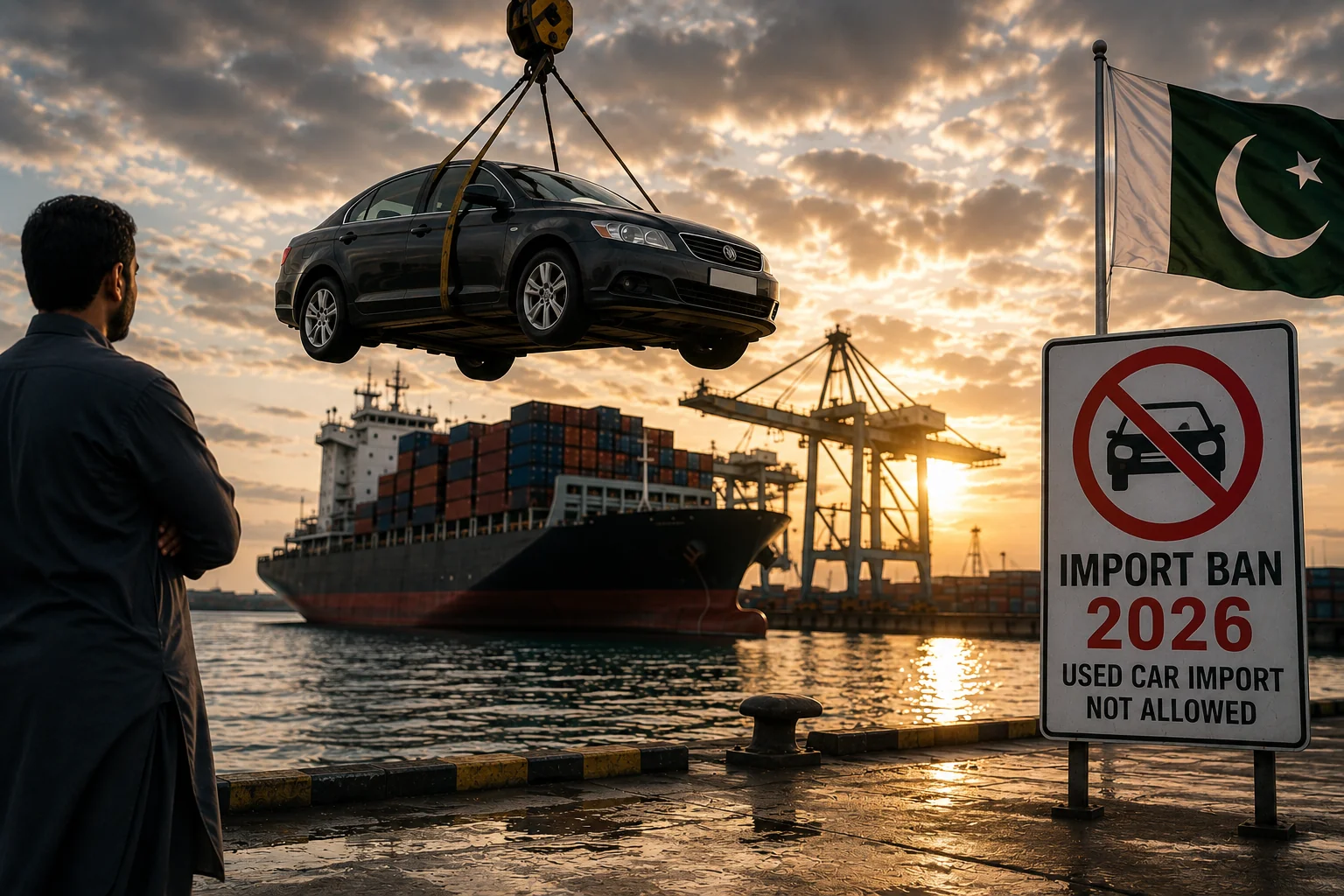
Customs duty on cars in Pakistan has not been removed. What changed in 2026 is which import route you can use to bring a car into the country. The government abolished the Personal Baggage Scheme for used vehicles, while duties and taxes on imported cars remain fully in force.
Quick Answer
Pakistan did not scrap customs duty on cars in 2026. It abolished the Personal Baggage Scheme for used-vehicle imports and tightened the Gift Scheme and Transfer of Residence Scheme. Overseas Pakistanis can still import a car through these two remaining routes, but duties and taxes still apply, and eligibility rules are stricter than before.
Customs Duty on Cars in Pakistan: What Changed in 2026?
The core change is which import route exists, not whether tax is owed. Three schemes used to let overseas Pakistanis bring in a used car. Now only two remain, and both carry tighter conditions than before.
The Personal Baggage Scheme has been abolished
Under SRO 61(I)/2026, dated January 15, 2026, the Ministry of Commerce removed the Personal Baggage Scheme from the Import Policy Order 2022. This scheme once accounted for roughly 99 percent of used-vehicle imports under the diaspora schemes, according to industry reporting, so its removal is the single biggest change for overseas Pakistanis wanting a used car.
Customs duty and taxes have not been removed
No scheme in Pakistan allows a car to enter duty-free as a general rule. Finance Minister Muhammad Aurangzeb told the National Assembly that no region or province permits duty- or tax-free vehicle imports. The remaining Gift and Transfer of Residence schemes still require payment of applicable customs duty, sales tax, and other charges.
Why the government changed the policy
The Ministry of Commerce said the Personal Baggage Scheme, though meant for genuine overseas Pakistanis, was routinely exploited by commercial traders who routed cars through third countries such as the UAE to bypass its intent. The reform followed an Economic Coordination Committee decision and came under pressure from Pakistan’s IMF program, which had flagged the scheme as widely misused.
Which Car Import Schemes Are Still Available?
Two personal-import routes remain open to eligible overseas Pakistanis: the Gift Scheme and the Transfer of Residence Scheme. Both existed before 2026, but the rules governing them are now stricter.
Gift Scheme
The Gift Scheme lets an eligible overseas Pakistani gift a vehicle to specific family members in Pakistan. Recipients are limited to parents, a spouse, children, brothers, and sisters. The scheme is not a duty-free route; applicable customs duty and taxes are paid as part of the process.
Transfer of Residence Scheme
The Transfer of Residence Scheme applies when a Pakistani national returns to live in Pakistan after a period abroad. Under the revised rules, the vehicle generally must come from the same country where the importer was residing, closing the third-country workaround that made the old Personal Baggage route easy to misuse.
Who can use these schemes?
Eligibility is limited to overseas Pakistanis and Pakistan Origin Card holders who meet the residency and stay conditions covered in the next section. You may be eligible if you meet these conditions, but eligibility is confirmed only after your documents are assessed by customs, not by meeting the general criteria alone.
New Eligibility Rules for Overseas Pakistanis
The 2026 reform added several conditions that did not exist, or were far looser, under the old rules. Missing any one of them can disqualify an import application.
Three-year overseas stay and 850-day requirement
Applicants generally need a minimum of three years of overseas residence, with at least 850 cumulative days spent abroad. This is stricter than the roughly two-year benchmark that older guidance referenced, and it is designed to filter out short trips arranged mainly to qualify for vehicle import.
Three-year gap between vehicle imports
The interval required between two vehicle imports by the same person has been increased from two years to three years. This reduces how often any single overseas Pakistani can use these schemes, which was one of the patterns customs officials linked to commercial misuse.
One-year restriction on selling or transferring the car
A vehicle imported under the Gift Scheme or Transfer of Residence Scheme cannot be sold or transferred for one year after import. Attempting an early transfer can result in registration being blocked and possible legal penalties, since the restriction is written into the SRO itself.
Pakistan Origin Card holders and eligible recipients
Pakistan Origin Card holders remain eligible under the applicable schemes, subject to the same residency and documentation conditions as other overseas Pakistanis. On the Gift Scheme side, only parents, a spouse, children, brothers, and sisters can legally receive a gifted vehicle.
What Cars Can Still Be Imported Into Pakistan?
Cars can still be imported under the Gift and Transfer of Residence schemes, but age, type, and origin restrictions apply on top of the eligibility rules above.
Age limit for imported cars
Cars imported under the remaining schemes must generally be no more than three years old. Other vehicle types can be up to five years old. Reporting also points to a possible removal of the age limit for commercial imports from July 2026, so the age rule for personal Gift and Transfer of Residence imports should not be assumed to match commercial import rules.
Rules for motorcycles and scooters
Motorcycles and scooters can only be imported under the Transfer of Residence Scheme. They are not eligible under the Gift Scheme, which is limited to cars and other four-wheeled vehicles under the current guidance.
Safety, environmental and regulatory standards
Some reporting on the 2026 reform references stricter pre-export checks, including proof that a vehicle is accident-free and meets recognised safety standards before it leaves the country of origin. Requirements can vary by vehicle type and origin country, so confirm the current documentation list with your clearing agent before shipment.
Country-of-residence rule under Transfer of Residence
Under the revised Transfer of Residence rules, the vehicle generally needs to come from the country where the importer actually lived, rather than being routed through a third country. This directly closes the loophole that let overseas Pakistanis in one country buy and ship a vehicle from a cheaper source country.
Is Car Import Duty-Free in Pakistan?
No. Pakistan does not offer a general exemption from customs duty and taxes for imported cars, and officials have stated this directly in response to public questions on the subject.
Why duties and taxes still apply
For old and used vehicles of Asian makes imported under the Gift or Transfer of Residence schemes, the FBR applies a fixed duty-and-tax amount in US dollars, based on engine capacity, rather than a percentage of the car’s value. A depreciation allowance of 1 percent per month applies according to the vehicle’s age, but the amount is never zero.
The limited disability-related concession
A separate, narrow concession applies to a new car of up to 1,350cc imported for an eligible person with a disability, subject to the required recommendation. This is the one documented exception where a duty concession applies, and it is not a general rule for overseas Pakistanis or ordinary importers.
Why exact tax calculations vary by vehicle
The final bill depends on engine capacity, vehicle age, the import scheme used, and filer status under Pakistan’s income tax rules, similar to the way filer versus non-filer status changes other vehicle-related payments. FBR’s own published guidance had not been fully updated at the time of writing, including its page still listing Personal Baggage as an active scheme, so treat any single flat figure with caution until confirmed for your specific case.
2026 Customs Duty and Tax Changes for Imported Cars
Two separate tariff changes took effect in 2026, on top of the scheme restructuring covered above.
Additional Customs Duty on vehicles above 1300cc
For imported vehicles above 1300cc, Additional Customs Duty was reduced from 6 percent to 4 percent, effective July 1, 2026, under SRO 1063(I)/2026. This applies to the additional customs duty component specifically, not the full tax bill on the vehicle.
Regulatory-duty changes for commercial used-car imports
The standalone regulatory duty on commercial used-vehicle imports was reduced from 40 percent to 30 percent from July 1, 2026. This follows a phase-down schedule reported alongside the policy: roughly 20 percent in FY2027-28, 10 percent in FY2028-29, and elimination by July 2029, subject to confirmation in each year’s finance notification. This change applies to commercial imports, not to personal imports under the Gift or Transfer of Residence schemes.
Why a lower standalone duty may not mean a lower total tax bill
A reduced regulatory duty rate does not automatically mean less tax overall. Other duties, levies, and Additional Customs Duty can still apply on the same vehicle, so the total landed cost depends on the full combination of charges rather than any single rate in isolation.
Customs Duty on Regular and Commercial Car Imports
New cars can be imported into Pakistan by anyone, not only overseas Pakistanis, provided applicable duties and taxes are paid. This is a separate track from the Gift and Transfer of Residence schemes above, with its own percentage-based duty structure tied to engine capacity and how the vehicle is imported.
CBU vs CKD: Why the Import Type Changes the Rate
Vehicles imported as Completely Built-Up (CBU) units generally face a higher combined duty than those imported as Completely Knocked Down (CKD) kits for local assembly. CKD rates have typically run 10 to 25 percent, since the policy favours local manufacturing, while CBU imports can carry combined duty and tax rates well above 50 percent depending on the vehicle category.
How Duty Has Varied by Engine Capacity
Reporting from before the 2026 reforms put combined customs duty, regulatory duty, and other levies at roughly 80 to 90 percent of CIF value for CBU imports up to 800cc, rising further for larger engines. These figures predate the July 2026 changes under SRO 1063(I)/2026 described above, so treat them as a general guide to how the structure works rather than a current exact rate, and confirm the latest applicable notification for your specific vehicle before relying on any single percentage.
Electric and Hybrid Vehicles
Some reporting describes a reduced ad valorem customs duty of around 25 percent for imported electric CBU passenger vehicles, well below the combined rates on conventional petrol and diesel cars. As with the hybrid concessions mentioned earlier, confirm the currently applicable rate with customs or a licensed agent before assuming an EV or hybrid discount still applies unchanged.
Personal Baggage vs Gift Scheme vs Transfer of Residence
Comparing the three routes side by side shows exactly what was removed and what remains, since the schemes are often confused with one another in casual conversation.
| Feature | Personal Baggage Scheme | Gift Scheme | Transfer of Residence |
| Status in 2026 | Abolished for used vehicles | Available under revised rules | Available under revised rules |
| Who can use it | Not applicable | Eligible overseas Pakistanis and POC holders | Eligible overseas Pakistanis and POC holders |
| Allowed recipients | Not applicable | Parents, spouse, children, brothers and sisters | Importer themselves, on return to Pakistan |
| Vehicle origin rule | Not applicable | Not generally applied under revised rule | Vehicle must come from country of overseas residence |
| Resale or transfer | Not applicable | No sale or transfer for one year | No sale or transfer for one year |
| Duties and taxes | Not applicable | Applicable | Applicable |
What is no longer allowed
The Personal Baggage Scheme itself, and the practice of routing a vehicle through a third country to qualify for import, are both no longer permitted under the current rules.
What remains allowed
Genuine overseas Pakistanis who meet the residency, stay, and gap requirements can still import a car through the Gift Scheme or Transfer of Residence Scheme, paying the applicable duties and taxes on the vehicle.
Which route may fit your situation?
If you are returning to live in Pakistan yourself, Transfer of Residence is generally the relevant route. If you plan to send a vehicle to a parent, spouse, child, or sibling while remaining abroad, the Gift Scheme is the one to check your eligibility against.
How the New Rules Affect Used-Car Buyers in Pakistan
The reform reaches beyond overseas Pakistanis directly filing an import application, changing supply and pricing across the used and new car market.
Overseas Pakistanis
Anyone who previously planned to use the Personal Baggage Scheme now needs to check eligibility under the Gift or Transfer of Residence Scheme instead, factoring in the longer residency requirement and the one-year resale restriction before committing to shipping costs.
Commercial importers
Commercial importers now operate under a separate percentage-based duty structure, with the regulatory duty cut from 40 percent to 30 percent from July 2026, rather than the fixed-amount structure used for personal Gift and Transfer of Residence imports.
Local used-car buyers
With roughly 90 percent of personal-scheme imports historically being small-engine Japanese cars, the removal of the Personal Baggage route is expected to reduce the supply of these vehicles, which industry commentary links to potential price increases in that segment.
Locally assembled vehicle market
A tighter import pipeline for used cars generally shifts some buyer demand toward locally assembled vehicles, though the extent of that shift depends on how quickly commercial import channels and pricing adjust to the new regulatory duty schedule.
Car Import Checklist Before You Apply
Before arranging shipment or payment, verify your scheme eligibility, vehicle age, total tax estimate, and required documentation with Pakistan Customs, the FBR, or a licensed customs agent.
- Confirm which scheme applies to your situation: Gift Scheme or Transfer of Residence.
- Check that you meet the three-year overseas stay and 850-day cumulative requirement.
- Confirm the three-year gap since your last vehicle import, if applicable.
- Verify the vehicle’s age falls within the current limit for its category.
- Under Transfer of Residence, confirm the vehicle originates from your actual country of residence.
- Get a written, vehicle-specific duty and tax estimate rather than relying on an old chart.
- Keep in mind the one-year restriction before you can sell or transfer the vehicle.
Frequently Asked Questions
What is the customs duty on cars in Pakistan in 2026?
There is no single customs duty rate for every imported car. The final duty and tax bill depends on vehicle type, engine capacity, age, declared value, the import route used, and the applicable notifications in force. Imported cars are not generally duty-free.
Is the Personal Baggage Scheme for cars banned in Pakistan?
Yes. Pakistan abolished the Personal Baggage Scheme for used-vehicle imports under SRO 61(I)/2026, effective January 15, 2026.
Can overseas Pakistanis still import cars to Pakistan?
Yes. Eligible overseas Pakistanis can still import vehicles through the Gift Scheme or Transfer of Residence Scheme, subject to the revised eligibility conditions and payment of applicable duties and taxes.
Can I import a car duty-free into Pakistan?
Generally, no. There is no general provision allowing duty-free import of cars or other vehicles into Pakistan. A limited concession may apply to an eligible person with a disability importing a new car up to 1,350cc, subject to the required recommendation.
How long must I stay abroad to import a car to Pakistan?
The revised rules generally require an overseas stay of at least three years, with a minimum cumulative stay of 850 days abroad.
Can I sell an imported car immediately in Pakistan?
No. Vehicles imported under the Gift Scheme or Transfer of Residence Scheme cannot be sold or transferred for one year after import.
What is the age limit for imported used cars in Pakistan?
Cars imported under the remaining schemes can generally be up to three years old. Other vehicle types can be up to five years old.
What changed in 2026 for commercial used-car imports?
The standalone regulatory duty on commercial used-vehicle imports was reduced from 40 percent to 30 percent from July 1, 2026. This does not automatically mean the final tax burden decreased, since other duties and levies can still apply.
Can anyone import a new car to Pakistan, or only overseas Pakistanis?
Anyone can import a new car into Pakistan by paying the applicable duties and taxes. The Gift and Transfer of Residence schemes are separate routes specifically for overseas Pakistanis, mainly used for used vehicles.
Do electric vehicles get a lower customs duty in Pakistan?
Some reporting points to a reduced ad valorem duty of around 25 percent for imported electric CBU vehicles, lower than combined rates on conventional cars. Confirm the current rate with customs before relying on it, since EV incentives have changed before.
Why does FBR’s website still mention the Personal Baggage Scheme?
FBR’s general procedural guidance had not been fully updated at the time of writing, and continues to list Personal Baggage as one of three schemes despite its removal under SRO 61(I)/2026. Rely on the SRO itself, or a licensed customs agent, over an unupdated summary page.
Duty Stayed. Only the Route Changed.
Once you separate the two questions, the confusion clears up. Customs duty on cars in Pakistan was never removed, only the Personal Baggage Scheme was. If you still qualify under the Gift or Transfer of Residence Scheme, you can import a car, but you will pay duty and tax on it either way.
Planning to import a car to Pakistan? Do not rely on old duty charts or social-media claims. Check the latest SROs, confirm your eligibility under the Gift Scheme or Transfer of Residence Scheme, and get a current, vehicle-specific tax estimate before proceeding. Once your car lands and gets registered, you will also need to budget for annual token tax going forward.
Which route are you checking eligibility for, Gift Scheme or Transfer of Residence? Let us know in the comments.
Last verified August 19, 2026, by the Chokus.pk desk, based on SRO 61(I)/2026, SRO 1063(I)/2026, and FBR’s published vehicle import guidance. Rules, rates, and eligibility conditions can change with each new notification; confirm your specific case with Pakistan Customs, the FBR, or a licensed customs agent before proceeding. This article is for general information only and does not constitute customs, tax, or legal advice.

Top 10 Best Swimming Pools for Kids in Karachi for Safe Family Fun
Fastest 4G Network in Pakistan: Which Network Comes Out on Top?