
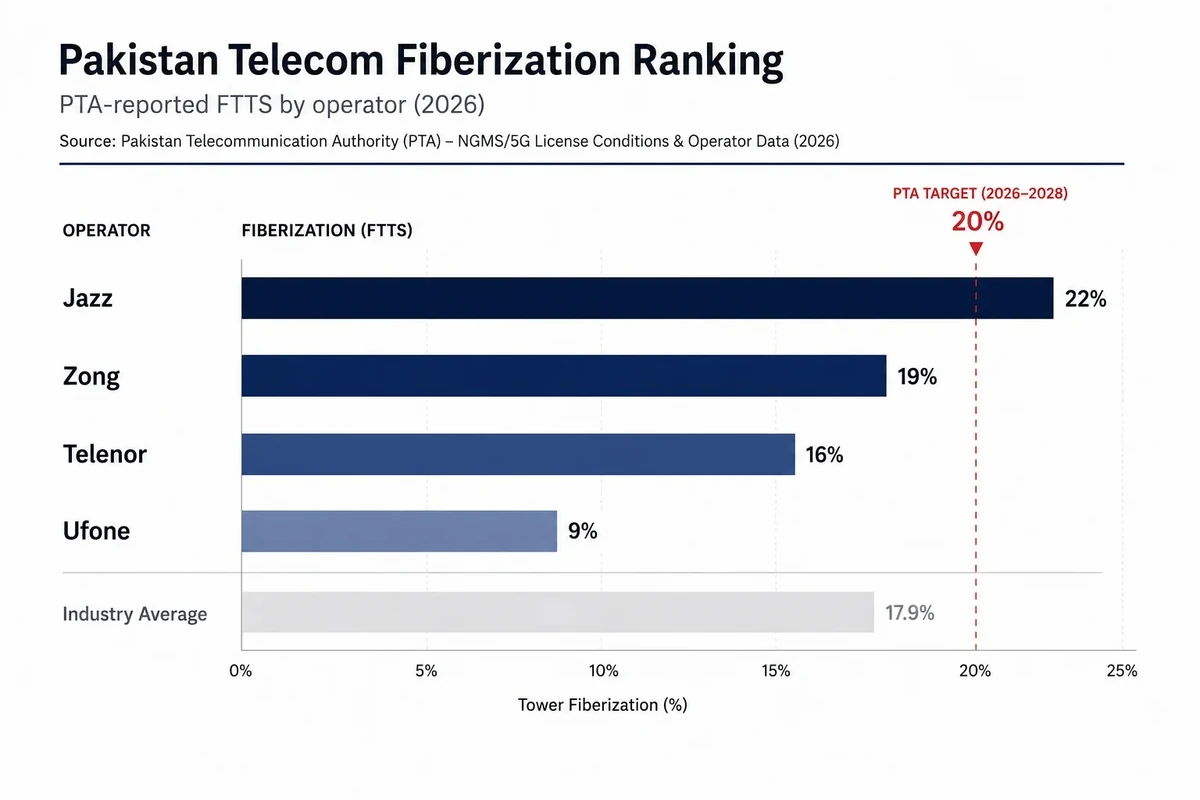
Pakistan’s telecom fiberization ranking has a clear leader and a clear laggard: Jazz sits at 22% tower fiberization, while Ufone trails badly at just 9%, according to official PTA documents released this week alongside new E-Band spectrum assignments meant to speed up 5G rollout. Overall, only 17.9% of Pakistan’s mobile towers are connected to fiber, well short of what nationwide 5G needs to actually work.
This matters more than most 5G headlines suggest, because pakistan 5g backhaul infrastructure, not spectrum alone, determines whether your phone actually gets fast, reliable 5G speeds once it reaches your area.
Quick Facts: Pakistan Telecom Fiberization Ranking
Fiber backhaul connects mobile towers to the core network, and Pakistan’s operators are nowhere near ready for full 5G despite already owning 5G spectrum. Here’s where the Pakistan telecom fiberization ranking currently stands for each operator.
| Operator | Tower Fiberization | Rank |
| Jazz | 22% | 1st |
| Zong | 19% | 2nd |
| Telenor | 16% | 3rd |
| Ufone | 9% | 4th |
| Industry average | 17.9% | N/A |
| PTA Phase-1 target (2026-28) | 20% minimum | Required |
What Is Tower Fiberization and Why Does It Matter for 5G?
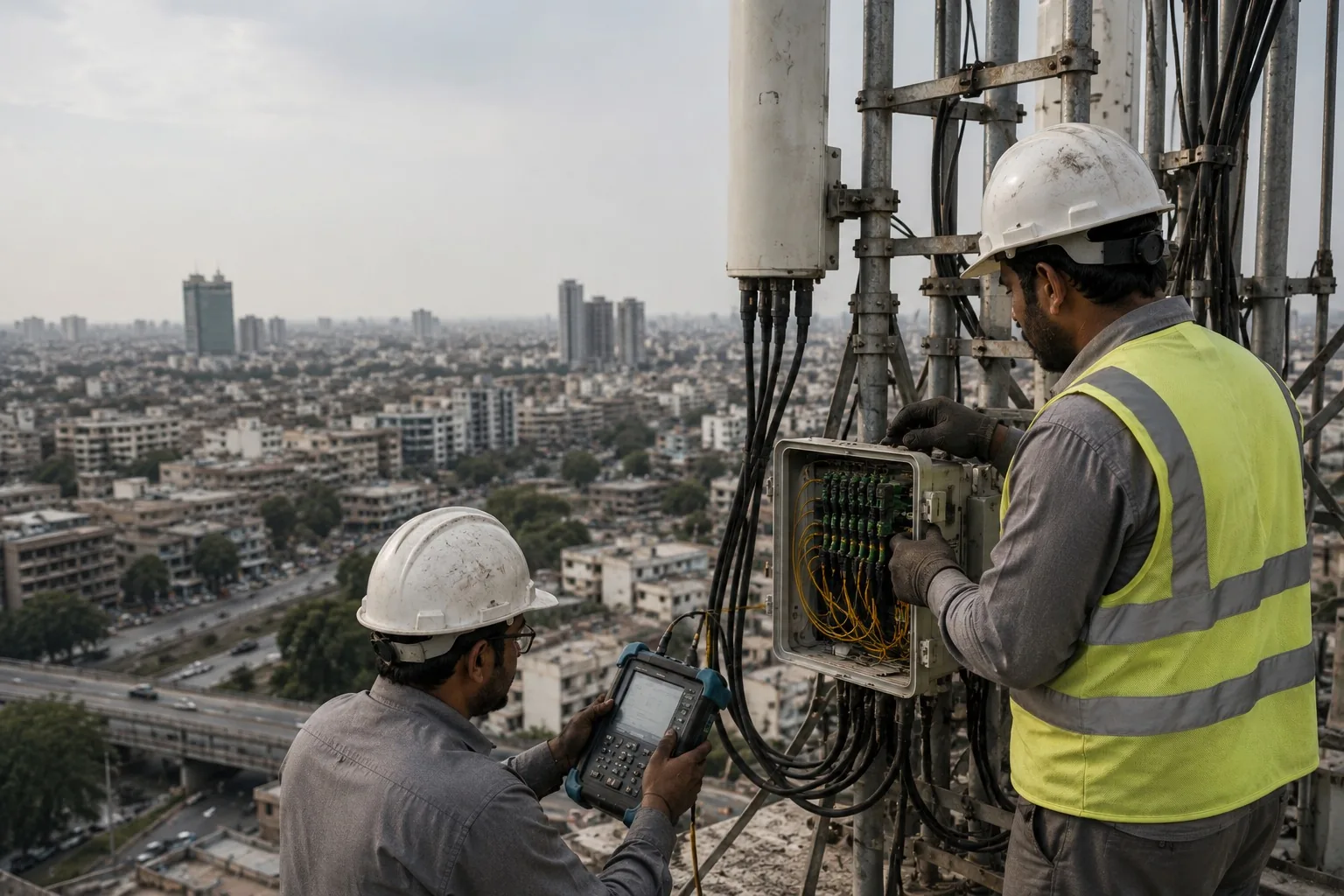
Tower fiberization means connecting a mobile tower directly to fiber-optic cable instead of relying on microwave links, and it’s the difference between 5G that merely exists and 5G that actually performs.
How Is Fiberization Different From Just Owning Spectrum?
Microwave backhaul works fine for 4G, but 5G’s higher speeds need the much larger data capacity that only fiber can reliably deliver. This is exactly why the pakistan telecom fiberization ranking matters more than raw spectrum ownership when judging real-world 5G potential.
What Fiberization Target Must Operators Hit?
Because of this gap, PTA’s NGMS/5G license conditions require every operator to hit at least 20% Fiber-to-the-Site (FTTS) coverage during Phase-1, which runs from 2026 to 2028. This pakistan 5g tower fiberization requirement applies equally to all four operators, regardless of how much spectrum each one owns. Right now, only Jazz is anywhere close to that target, and the other three operators still have real ground to cover.
Pakistan Telecom Fiberization Ranking: Who’s Leading?
If you’re asking which telecom has the most fiber towers Pakistan operators can offer right now, the answer is unambiguous, Jazz sits well ahead of the rest of the industry.
How Do the Four Operators Rank Against Each Other?
Jazz’s 22% fiberization puts it ahead of the entire industry, and ahead of the regulator’s own minimum target two years early. Zong follows at 19%, close behind but still short of the threshold. Telenor sits at 16%, and Ufone lags well behind at just 9%, roughly a quarter of Jazz’s fiber footprint despite being one of Pakistan’s largest operators by subscriber count.
Why Does This Ranking Matter More Than It Seems?
This Jazz, Zong, Telenor, Ufone fiberization percentage gap isn’t just a technical detail. It’s a fairly reliable predictor of which network’s 5G experience will actually feel fast once towers go live in your area, versus which one will look good on a spec sheet but disappoint in daily use. This is a separate measure from PTA’s overall quality-of-service rankings, which track today’s speed and coverage rather than tomorrow’s 5G capacity.
Why Is Ufone So Far Behind on Fiberization?
Ufone’s lag likely traces back to its later, slower rollout of digital infrastructure investment compared to Jazz and Zong, both of which have spent years building fiber networks for enterprise and broadband customers that now double as 5G backhaul. Ufone’s parent company PTCL does operate extensive fiber infrastructure nationally, though that hasn’t yet translated into telecom fiber to the site pakistan connections for Ufone’s mobile network specifically.
Given Ufone only recently completed its merger with Telenor Pakistan, integrating and prioritizing fiber rollout across a newly combined network may explain part of the delay. Ufone 5g readiness in Pakistan will likely depend on how quickly this merged network can consolidate its infrastructure spending, though PTA’s target timeline doesn’t offer much room for catching up gradually.
What Is the New E-Band Spectrum PTA Just Gave Telecoms?
PTA’s E-Band spectrum assignment, announced this week, gives operators additional high-frequency spectrum specifically for point-to-point microwave links between towers, a stopgap that can boost backhaul capacity faster than laying new fiber.
How Does E-Band Microwave Compare to Fiber Backhaul?
| Factor | Fiber Backhaul | E-Band Microwave |
| Deployment speed | Slow (requires trenching) | Fast (line-of-sight radio link) |
| Long-term capacity | Very high, future-proof | High, but distance-limited |
| Best suited for | Permanent, high-density coverage | Quick fixes in dense urban areas |
| Cost over time | Higher upfront, cheaper long-term | Lower upfront, ongoing limitations |
| Weather sensitivity | None | Some signal loss in heavy rain |
Since pta e-band spectrum 5g assignments work over shorter distances at very high capacity, they’re best suited for dense urban areas where fiber trenching is slow or expensive.
Does E-Band Spectrum Replace the Need for Fiber?
No. This doesn’t replace the need for fiber long-term, but it buys operators time to hit PTA’s Phase-1 targets without falling further behind on 5G quality while fiber rollout catches up. For Jazz specifically, whose jazz 5g infrastructure Pakistan lead already exceeds the current target, E-Band spectrum offers a way to extend that advantage into areas where trenching fiber would take years.
What Does This Mean for 5G Users in Pakistan?
If you’re choosing a network based on 5G potential rather than current pricing or packages, this Pakistan telecom fiberization ranking is a better predictor of future performance than marketing claims. Jazz and Zong’s stronger fiberization suggests more consistent 5G speeds as rollout expands, while Ufone customers may see slower improvements in areas without existing fiber.
For a broader look at pricing, coverage, and day-to-day network comparisons beyond 5G readiness specifically, Chokus covers this in its Best Mobile Network comparison, and for ongoing 5G and spectrum developments, see our telecom news coverage.
Frequently Asked Questions
What is Pakistan’s telecom fiberization ranking right now?
Jazz leads at 22% tower fiberization, followed by Zong at 19%, Telenor at 16%, and Ufone at 9%, against an industry average of 17.9%.
Why does tower fiberization matter for 5G performance?
5G needs much higher data capacity between towers and the core network than 4G does, and only fiber-optic backhaul reliably delivers that capacity at scale, unlike microwave links.
Which telecom has the most fiber towers in Pakistan?
According to the current Pakistan telecom fiberization ranking, Jazz leads with 22% of its towers connected to fiber, ahead of Zong, Telenor, and Ufone.
Why is Ufone behind on 5G infrastructure readiness?
Ufone’s slower fiber rollout compared to Jazz and Zong, combined with its recent merger integration with Telenor Pakistan, likely explains its lower 9% fiberization rate.
What is PTA’s E-Band spectrum assignment for?
It gives operators additional high-frequency spectrum for point-to-point microwave links between towers, helping boost backhaul capacity faster than fiber alone in areas where trenching fiber is slow.
What fiberization target do operators need to hit?
PTA’s NGMS/5G license conditions require a minimum 20% Fiber-to-the-Site ratio during Phase-1, covering 2026 to 2028.
Does higher fiberization mean better 5G speeds for users?
Generally yes. Networks with more fiber-connected towers can typically deliver more consistent 5G speeds as rollout expands, compared to operators still relying heavily on microwave backhaul.
Final Word
Pakistan’s telecom fiberization ranking tells a story that spectrum auctions alone don’t: owning 5G licenses means little without the fiber backbone to support them. Jazz’s early lead and Ufone’s lag both make sense once you look past headlines about spectrum auctions and licenses toward the physical infrastructure actually being built.
Which network do you use, and has your 5G experience matched what this fiberization ranking would predict? Let us know in the comments.
Written by the Chokus.pk team. Last updated July 22, 2026, based on PTA’s official E-Band spectrum assignment documents, the most recent data available at the time of publishing.